
 |
 |
 |
 |
 |
 |
 |
 |
 |

 |

Paris (AFP) Jan 26, 2011 Astronomers on Wednesday said they had snared an image of what may be the oldest galaxy ever seen, a starry cluster that came into being when the Universe was still a baby. The tiny smudge of light captured by the orbiting Hubble telescope took 13.2 thousand million years to reach Earth, which means the galaxy was born some 480 million years after the "Big Bang" that created the cosmos. Even older galaxies are likely to be out there, but they will only be detected with next-generation sensors aboard the Hubble's successor, they said. "We're getting back very close to the first galaxies, which we think formed around 200 to 300 million years after the Big Bang," said Garth Illingworth, professor of astronomy and astrophysics at the University of California at Santa Cruz. Astronomers measuring the age of starlight look for something called redshift: the farther that light travels, the longer and "redder" become its wavelength. A high redshift number thus indicates that the object is old, for the light it emitted has taken billions of years to reach us across the expanding Universe. The new-found galaxy, UDFj-39546824, was found in a fingernail-sized sector of sky called the Hubble Ultra-Deep Field during 87 hours of scans in 2009 and 2010. Its finders calculate the redshift as a whopping 10.3, far older than the previous record for a galaxy of 8.6, announced by an international team last October. "This result is on the edge of our capabilities, but we spent months doing tests to confirm it, so we now feel pretty confident," Illingworth said in a press release. For all its great age, this early galaxy is a tiddler compared to those which came later. Our own Milky Way is 100 times bigger. The observations also netted three other galaxies with redshifts higher than 8.3. Put together, these discoveries suggest galaxies underwent a dramatic change from about 480 million to 650 million years after the Big Bang, according to the study, published in the British science journal Nature. During these 170 million years, the rate of star birth in the early Universe increased tenfold. "This is an astonishing increase in such a short period, just one percent of the current age of the Universe," Illingworth noted. Just as stars multiplied, so did the number of galaxies, and this backs theories that galactic formation is forged by the gravitational pull of a poorly-understood entity, dark matter. The observations were made thanks to the new Wide Field Camera 3, installed on the Hubble Space Telescope by NASA astronauts in a servicing mission last May. The Wide Field Camera boosted redshift sensitivity by a factor of at least 30 compared with the telescope's previous equipment. But a redshift of 10.3 is likely to be its very limit. To dig deeper into time, astronomers will need the James Webb Space Telescope, which NASA hopes to launch in 2014.
Share This Article With Planet Earth
Related Links Understanding Time and Space

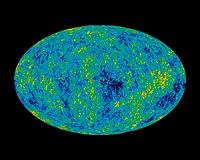 The Big Bang
Bethesda MD (SPX) Jan 18, 2011 The night sky seems to present a view of a calm and unchanging Universe. But, in 1929, Edwin Hubble discovered that the Universe is, in fact, expanding at enormous speed. He noted that galaxies outside our own Milky Way were all moving away from us, each at a speed proportional to its distance from us. He quickly realized what this meant that there must have been an instant in time (now kn ... read more |
|
|
| The content herein, unless otherwise known to be public domain, are Copyright 1995-2010 - SpaceDaily. AFP and UPI Wire Stories are copyright Agence France-Presse and United Press International. ESA Portal Reports are copyright European Space Agency. All NASA sourced material is public domain. Additional copyrights may apply in whole or part to other bona fide parties. Advertising does not imply endorsement,agreement or approval of any opinions, statements or information provided by SpaceDaily on any Web page published or hosted by SpaceDaily. Privacy Statement |


 del.icio.us
 Digg
Digg Reddit
 YahooMyWeb
 Google
 Facebook


