
 |
 |
 |
 |
 |
 |
 |
 |
 |

 |
Dog Owners Need To Wash Hands
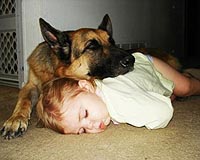
Manhattan KS (SPX) Jan 29, 2009 Dog owners who sleep with their pet or permit licks on the face are in good company. Surveys show that more than half of owners bond with their pets in these ways. Research done by a veterinarian at Kansas State University found that these dog owners are no more likely to share the same strains of E. coli bacteria with their pets than are other dog owners. Dr. Kate Stenske, a clinical assistant professor at K-State's College of Veterinary Medicine, studied this association as part of her doctoral research at the University of Tennessee. The research is scheduled to appear in an upcoming issue of the American Journal of Veterinary Research. Stenske said the finding that these human-animal bonding behaviors aren't more likely to spread germs is good news because there are physical and psychological benefits of pet ownership. "I became interested in the topic because there is such a strong bond between dogs and their owners," Stenske said. "If you look at one study, 84 percent of people say their dog is like a child to them." Stenske said surveys also show that nearly half of all dog owners share food with their dogs, and more than half allow the dog to sleep in the bed and lick them on the face. "We also know diseases can be shared between dogs and people," Stenske said. "About 75 percent of emerging diseases are zoonotic, meaning they are transferrable between humans and other animals. With these two pieces of knowledge, I wanted to examine the public health aspects of such activities." Stenske's study centered on E. coli bacteria, which is common in the gastrointestinal tracts of both dogs and humans. "People have it, dogs have it, and it normally doesn't cause any problems," she said. "But it can acquire genes to make it antibiotic resistant." The study examined fecal samples from dogs and their owners and looked at the bacteria's DNA fingerprints. Stenske found that 10 percent of dog-human pairs shared the same E. coli strains. She also found that the E. coli had more resistance to common antibiotics than expected, although the owners had more multiple-drug resistant strains than their pets. "This make us think that dogs are not likely to spread multiple drug-resistant E. coli to their owners, but perhaps owners may spread them to their dogs," Stenske said. "What we learn from this is that antibiotics really do affect the bacteria within our gastrointestinal tract, and we should only take them when we really need to - and always finish the entire prescription as directed." The research showed that bonding behaviors like sharing the bed or allowing licks on the face had no association to an increase in shared E. coli. However, Stenske said the research did show an association between antibiotic-resistant E. coli and owners who didn't wash their hands after petting their dogs or before cooking meals. "We should use common sense and practice good general hygiene," she said. Stenske said future research might focus on the relationship between shared E. coli and the behaviors of cat owners. Not only is cat ownership higher than dog ownership in the United States, but cats also interact with people in different ways than dogs, she said. "We have a lot to learn," Stenske said. "In the meantime, we should continue to own and love our pets because they provide a source of companionship. We also need to make sure we are washing our hands often." Share This Article With Planet Earth
Related Links Kansas State University Darwin Today At TerraDaily.com
 How Does A Dog Walk? Surprisingly, Many Of Us Don't Really Know
 Budapest, Hungary (SPX) Jan 29, 2009
Despite the fact that most of us see our four-legged friends walking around every day, most of us-including many experts in natural history museums and illustrators for veterinary anatomy text books-apparently still don't know how they do it. |
|
|

| The content herein, unless otherwise known to be public domain, are Copyright 1995-2007 - SpaceDaily.AFP and UPI Wire Stories are copyright Agence France-Presse and United Press International. ESA Portal Reports are copyright European Space Agency. All NASA sourced material is public domain. Additional copyrights may apply in whole or part to other bona fide parties. Advertising does not imply endorsement,agreement or approval of any opinions, statements or information provided by SpaceDaily on any Web page published or hosted by SpaceDaily. Privacy Statement |
 del.icio.us
 Digg
Digg Reddit
 YahooMyWeb
 Google
 Facebook