
 |
 |
 |
 |
 |
 |
 |
 |
 |

 |
ESA Director General Addresses USRA 40th Anniversary Symposium
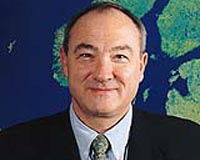
Columbia MD (SPX) Apr 04, 2009 The Universities Space Research Association (USRA) hosted their 40th anniversary symposium, "Our Future in Space," on Thursday, March 26 at the National Academy of Sciences in Washington, D.C. Director General Jean-Jacques Dordain of the European Space Agency (ESA) addressed the audience of professors, deans, and leaders in the space research field from industry and government, including international representatives. In his remarks, Director General Jean-Jacques Dordain underlined the key role of international cooperation for the past achievements in space as well as for mastering its future challenges. Referring to ESA, which federates the interests of 18 Member States and Canada as cooperating state, and its long history of worldwide cooperation, Mr. Dordain explained that "for the European Space Agency, international cooperation is not only a tool, but a culture." Areas where international cooperation is expected to play an increasingly important role in the future is space science ("all scientific calls for proposal of ESA are open to the worldwide scientific community"), climate change research ("a global approach is necessary, because climate change is a global issue"), and human space exploration ("the exploration of the Moon was initially the success of one country, the International Space Station hosts now five international partners, the future exploration of Moon and Mars will be a global endeavor"). With respect to the International Space Station program, Mr. Dordain remarked that the international cooperation established through his program is a strong asset that should form the nucleus upon which a global exploration program should be defined and developed. Mr. Dordain conceded that international cooperation is not always easy, "but it is even more difficult to succeed alone." Success factors for international cooperation are: clearly defined projects, flexibility in project implementation ("cooperation has to be a facilitator, not a constraint"), clear governance, transparency among the partners, no exchange of funds, and good personal relationships. Concluding his address, Mr. Dordain declared that "nothing is possible without people" and therefore, as important as international cooperation is the cooperation between successive generations and transmitting expertise to the young generation. Organizations like USRA are playing an essential role in this respect and Mr. Dordain extended his congratulations to USRA's 40th anniversary. Referring to the network of space universities in Europe, where "international cooperation is already manifest in the curriculum," Mr. Dordain, who is also chancellor of the International Space University (ISU), expressed his hope that this network and ISU could learn from the experience that USRA has gained during this long time of operation. Dr. Frederick A. Tarantino, President and CEO of USRA, said, "International cooperation is key to our future space program. The demands of future civil space missions, from studying and monitoring climate change to exploration of the Moon and solar system to fundamental studies of the universe, will achieve their objectives quicker through international partnership. The scientific space research community is already international. And expanding cooperation in the development and operation of space missions will help solidify our international relationships and strengthen humankind's capability to achieve common goals. We appreciate Mr. Dordain addressing our member universities and visiting with us on the occasion of our 40th anniversary." Commemorating USRA's 40th anniversary, the symposium explored the roles of research universities in civil, commercial, national security, and international space. Other speakers included: Harrison Schmitt, Apollo 17 NASA Astronaut, former U.S. Senator from New Mexico, and recent Chair of the NASA Advisory Council; Anousheh Ansari, Co-founder and Chairman of Prodea Systems and first female private space explorer and sponsor of the Ansari X Prize; and Paul Kaminski, Chairman and CEO of Technovation, and former Under Secretary of Defense for Acquisition and Technology. The symposium was attended by the four past USRA presidents: Dr. A.R. Kuhlthau (1969-1976), Dr. Alexander J. Dessler (1976-1981); Dr. Paul J. Coleman (1981-2000); Dr. David C. Black (2000-2006); and the current president, Dr. Tarantino (2006-present). The two newest member universities attended the symposium and were unanimously voted into the Association: Howard University in Washington, D.C. and The Chinese University of Hong Kong. Share This Article With Planet Earth
Related Links Universities Space Research Association European Space Agency (ESA) The latest information about the Commercial Satellite Industry
 Northrop Grumman Pays To Settle Case On Faulty MilSat Parts
 Los Angeles CA (SPX) Apr 04, 2009
TRW Inc.'s efforts to stop a scientist from revealing his research findings about faulty electronic components the company sold to the government for military and intelligence-gathering satellites were the basis for a whistleblower lawsuit that Northrop Grumman, which acquired TRW, settled for $325 million. |
|
|

| The content herein, unless otherwise known to be public domain, are Copyright 1995-2007 - SpaceDaily.AFP and UPI Wire Stories are copyright Agence France-Presse and United Press International. ESA Portal Reports are copyright European Space Agency. All NASA sourced material is public domain. Additional copyrights may apply in whole or part to other bona fide parties. Advertising does not imply endorsement,agreement or approval of any opinions, statements or information provided by SpaceDaily on any Web page published or hosted by SpaceDaily. Privacy Statement |
 del.icio.us
 Digg
Digg Reddit
 YahooMyWeb
 Google
 Facebook