|
 |
 |
 |
 |
 |
 |
 |
 |

 |
ESA Science At Le Bourget
Le Bourget, France (ESA) Jun 21, 2007 This week, from 18 to 24 June, the 47th Paris Air Show is being held at Le Bourget. The event has again gathered many companies from the international air and space industry. ESA as well as a lot of the agency's industrial partners are also present and several important contracts and agreements have been signed for some of the space agency's missions that are in development.
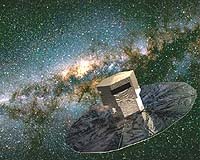
Contract for Development of Gaia Mirrors Gaia, ESA's future astrometric mission currently scheduled for launch in 2011, is dedicated to the mapping of the billion brightest objects in the sky with as main goal to produce a three-dimensional map of our Galaxy with unprecedented accuracy. To this end, Gaia will use two telescopes, each with a primary mirror that is 1.45 x 0.5 m in size. The mirrors and telescope structures will be built using ultra-stable silicon-carbide (SiC) material to provide low mass, isotropy, thermo-elastic stability and dimensional stability during the operational lifetime in space. The two mirrors will have to be polished to a precision of less than 10 nm.
Herschel/Planck AOCS Systems In Planck the system shall maintain the spacecraft's spinning axis direction always orientated near the anti-Sun vector, with a maximum deviation of +/- 10 degrees. After launch, Planck is spin stabilised and will be put in a Lissajous orbit about the second Lagrange point L2 of the Earth-Sun system, from where the spacecraft payload will map the Cosmic Microwave Background across the whole sky. For Herschel, high accuracy 3-axis pointing is achieved through operating 20 N thrusters and reaction wheels, based on the accurate attitude determination by autonomous star trackers and gyroscopes.
Agreements on JWST and LISA Pathfinder Scheduled for launch in 2013 and generally seen as Hubble's direct successor, the James Webb Space Telescope (JWST) is a project of international collaboration between NASA, ESA and the Canadian Space Agency. The LISA-Pathfinder mission is a crucial stepping stone toward the future ESA/NASA LISA mission that will detect and measure gravitational waves in space using multiple spacecraft flying in formation. For the full ESA press release and details of the agreements, please see the related link "Signing of JWST and LISA Pathfinder agreements" in the right hand side navigation. Community Email This Article Comment On This Article Related Links Gaia Mission Planck Mission Herschel Mission JWST Mission LISA Pathfinder The latest information about the Commercial Satellite Industry
 Lockheed Martin Set To Deliver BSAT-3A And JCSAT-11 Spacecraft In 3rd Quarter Of 2007
 Paris (SPX) Jun 20, 2007
Lockheed Martin is poised to deliver two spacecraft in the third quarter of 2007 for two premiere customers, the Broadcasting Satellite System Corporation (B-SAT) and the JSAT Corporation (JSAT), both based in Japan. BSAT-3a, designed and built for B-SAT, recently completed its Pre-Shipment Review and is in preparation for shipment to the Arianespace launch site in French Guiana. |
|
|
| The content herein, unless otherwise known to be public domain, are Copyright Space.TV Corporation. AFP and UPI Wire Stories are copyright Agence France-Presse and United Press International. ESA Portal Reports are copyright European Space Agency. All NASA sourced material is public domain. Additional copyrights may apply in whole or part to other bona fide parties. Advertising does not imply endorsement, agreement or approval of any opinions, statements or information provided by Space.TV Corp on any Web page published or hosted by Space.TV Corp. Privacy Statement |