
 |
 |
 |
 |
 |
 |
 |
 |
 |

 |
ESF Launches Humans In Outer Space Book
Paris, France (SPX) Nov 10, 2008 Although there are still arguments about whether humans are destined for space, we have had a permanent human presence in Earth's orbit since the first crew occupied the International Space Station eight years ago, and the technology for private space flight is in the making. But, if people leave Earth in large numbers, what will we do? More importantly, who will we be? These questions and more are addressed in the new book Humans in Outer Space - Interdisciplinary Odysseys, by the European Science Foundation (ESF) and the European Space Policy Institute. The book is the outcome of the Humans in Outer Space: An Interdisciplinary Odyssey conference held in Vienna last year. That meeting, organised by the European Science Foundation (ESF), the European Space Agency (ESA) and the European Space Policy Institute (ESPI), brought together humanities researchers from around the world, to bring their perspectives to a field long the preserve of engineers and physicists. The goal was to put human's extra-terrestrial endeavours in context by applying the analytic techniques of the humanities and social sciences. "We can compare space to the exploration of the New World in the 16th century. That is the character of the exploration we are conducting now when we go out from the Earth," says Professor Dr. Kai-Uwe Schrogl, the Director for the European Space Policy Institute. He explained that Humans in Outer Space - Interdisciplinary Odysseys explores the stages of human exploration of space described in the Vienna Vision, which calls for greater participation of humanities into space policy. The first two "Odysseys" described in the Vienna Vision are either happening now or planned for the next few decades: first, a permanent human orbit of Earth, then a return to the moon, and a human landing on Mars. The third Odyssey is the exploration of worlds beyond our solar system, and possible contact with other life forms. Humankind's journey through these stages will put us face to face with the kinds of challenges that can only be resolved with reference to the humanities: questions of law, religion, ethics. How would religion cope with extra terrestrial life? How will humans cope with long periods in isolation, utterly dependant on technology for survival? What are the political implications of human settlements on other worlds? According to Professor Dr. Ulrike Landfester from Universit�t St. Gallen, these questions and others must be considered before humankind begins the transition from Homo erectus to Homo celesticus. "We are now running the risk of constructing ideas about outer space reality which might at some future time impede our dealings with it," she said. Humans in Outer Space - Interdisciplinary Odysseys and the Vienna Vision, aim to move the conversation about space exploration away from rocket capacity and back to human capacity. Over the last year, the Vienna Vision has been circulated amongst policy makers and experts. Share This Article With Planet Earth
Related Links European Space Policy Institute Space Tourism, Space Transport and Space Exploration News
 Universal Declaration Of Human Rights Flies Into Space
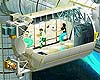 Paris, France (ESA) Nov 07, 2008
"All human beings are born free and equal in dignity and rights. They are endowed with reason and conscience and should act towards one another in a sprit of brotherhood", states Article 1 of the Universal Declaration of Human Rights (UDHR). |
|
|

| The content herein, unless otherwise known to be public domain, are Copyright 1995-2007 - SpaceDaily.AFP and UPI Wire Stories are copyright Agence France-Presse and United Press International. ESA Portal Reports are copyright European Space Agency. All NASA sourced material is public domain. Additional copyrights may apply in whole or part to other bona fide parties. Advertising does not imply endorsement,agreement or approval of any opinions, statements or information provided by SpaceDaily on any Web page published or hosted by SpaceDaily. Privacy Statement |
 del.icio.us
 Digg
Digg Reddit
 YahooMyWeb
 Google
 Facebook