
 |
 |
 |
 |
 |
 |
 |
 |
 |

 |

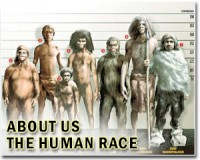
Chicago IL (SPX) Feb 21, 2011 That human evolution follows a progressive trajectory is one of the most deeply-entrenched assumptions about our species. This assumption is often expressed in popular media by showing cavemen speaking in grunts and monosyllables (the GEICO Cavemen being a notable exception). But is this assumption correct? Were the earliest humans significantly different from us? In a paper published in the latest issue of Current Anthropology, archaeologist John Shea (Stony Brook University) shows they were not. The problem, Shea argues, is that archaeologists have been focusing on the wrong measurement of early human behavior. Archaeologists have been searching for evidence of "behavioral modernity", a quality supposedly unique to Homo sapiens, when they ought to have been investigating "behavioral variability," a quantitative dimension to the behavior of all living things. Human origins research began in Europe, and the European Upper Paleolithic archaeological record has long been the standard against which the behavior of earlier and non-European humans is compared. During the Upper Paleolithic (45,000-12,000 years ago), Homo sapiens fossils first appear in Europe together with complex stone tool technology, carved bone tools, complex projectile weapons, advanced techniques for using fire, cave art, beads and other personal adornments. Similar behaviors are either universal or very nearly so among recent humans, and thus, archaeologists cite evidence for these behaviors as proof of human behavioral modernity. Yet, the oldest Homo sapiens fossils occur between 100,000-200,000 years ago in Africa and southern Asia and in contexts lacking clear and consistent evidence for such behavioral modernity. For decades anthropologists contrasted these earlier "archaic" African and Asian humans with their "behaviorally-modern" Upper Paleolithic counterparts, explaining the differences between them in terms of a single "Human Revolution" that fundamentally changed human biology and behavior. Archaeologists disagree about the causes, timing, pace, and characteristics of this revolution, but there is a consensus that the behavior of the earliest Homo sapiens was significantly that that of more-recent "modern" humans. Shea tested the hypothesis that there were differences in behavioral variability between earlier and later Homo sapiens using stone tool evidence dating to between 250,000- 6000 years ago in eastern Africa. This region features the longest continuous archaeological record of Homo sapiens behavior. A systematic comparison of variability in stone tool making strategies over the last quarter-million years shows no single behavioral revolution in our species' evolutionary history. Instead, the evidence shows wide variability in Homo sapiens toolmaking strategies from the earliest times onwards. Particular changes in stone tool technology can be explained in terms of the varying costs and benefits of different toolmaking strategies, such as greater needs for cutting edge or more efficiently-transportable and functionally-versatile tools. One does not need to invoke a "human revolution" to account for these changes, they are explicable in terms of well-understood principles of behavioral ecology. This study has important implications for archaeological research on human origins. Shea argues that comparing the behavior of our most ancient ancestors to Upper Paleolithic Europeans holistically and ranking them in terms of their "behavioral modernity" is a waste of time. There are no such things as modern humans, Shea argues, just Homo sapiens populations with a wide range of behavioral variability. Whether this range is significantly different from that of earlier and other hominin species remains to be discovered. However, the best way to advance our understanding of human behavior is by researching the sources of behavioral variability in particular adaptive strategies. John Shea, "Homo sapiens is as Homo sapiens was: Behavioral variability vs. 'behavioral modernity' in Paleolithic archaeology." Current Anthropology 54:1 (February 2011).
Share This Article With Planet Earth
Related Links University of Chicago Press Journals All About Human Beings and How We Got To Be Here

 Mind-moved bionic arm goes on display in US
Washington (AFP) Feb 17, 2011 A bionic prosthetic arm that is controlled by its operator's thoughts and feels like the amputee's lost limb went on display Thursday at a major US science conference. More than 50 amputees worldwide, many of them military veterans whose limbs were lost in combat, have received such devices since they were first developed by US doctor Todd Kuiken in 2002. The arm uses technology called ... read more |
|
|
| The content herein, unless otherwise known to be public domain, are Copyright 1995-2010 - SpaceDaily. AFP and UPI Wire Stories are copyright Agence France-Presse and United Press International. ESA Portal Reports are copyright European Space Agency. All NASA sourced material is public domain. Additional copyrights may apply in whole or part to other bona fide parties. Advertising does not imply endorsement,agreement or approval of any opinions, statements or information provided by SpaceDaily on any Web page published or hosted by SpaceDaily. Privacy Statement |


 del.icio.us
 Digg
Digg Reddit
 YahooMyWeb
 Google
 Facebook


