
 |
 |
 |
 |
 |
 |
 |
 |
 |

 |
Earth's Crust Melts Easier Than Thought
Washington DC (SPX) Mar 26, 2009 Earth's crust melts easier than previously thought, scientists have discovered. In a paper published in this week's issue of the journal Nature, geologists report results of a study of how well rocks conduct heat at different temperatures. They found that as rocks get hotter in Earth's crust, they become better insulators and poorer conductors. The findings provide insights into how magmas are formed, the scientists say, and will lead to better models of continental collision and the formation of mountain belts. "These results shed important light on a geologic question: how large bodies of granite magma can be formed in Earth's crust," said Sonia Esperanca, a program director in the National Science Foundation (NSF)'s Division of Earth Sciences, which funded the research. "In the presence of external heat sources, rocks heat up more efficiently than previously thought," said geologist Alan Whittington of the University of Missouri. "We applied our findings to computer models that predict what happens to rocks when they get buried and heat up in mountain belts, such as the Himalayas today or the Black Hills in South Dakota in the geologic past. "We found that strain heating, caused by tectonic movements during mountain belt formation, easily triggers crustal melting." In the study, the researchers used a laser-based technique to determine how long it took heat to conduct through different rock samples. In all their samples, thermal diffusivity, or how well a material conducts heat, decreased rapidly with increasing temperatures. The thermal diffusivity of hot rocks and magmas was half that of what had been previously assumed. "Most crustal melting on Earth comes from intrusions of hot basaltic magma from the Earth's mantle," said Peter Nabelek, also a geologist at the University of Missouri. "The problem is that during continental collisions, we don't see intrusions of basaltic magma into continental crust." These experiments suggest that because of low thermal diffusivity, strain heating is much faster and more efficient. Once rocks get heated, they stay hotter for much longer, Nabelek said. The processes take millions of years to happen, and scientists can only simulate them on a computer. The new data will allow them to create computer models that more accurately represent processes that occur during continental collisions. Share This Article With Planet Earth
Related Links National Science Foundation Tectonic Science and News
 Strong earthquake hits Papua New Guinea: USGS
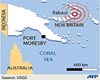 Sydney (AFP) March 25, 2009
A strong 6.0-magnitude earthquake struck Papua New Guinea on Wednesday morning, the US Geological Survey said, but there were no immediate reports of damage or casualties on the ground. |
|
|

| The content herein, unless otherwise known to be public domain, are Copyright 1995-2007 - SpaceDaily.AFP and UPI Wire Stories are copyright Agence France-Presse and United Press International. ESA Portal Reports are copyright European Space Agency. All NASA sourced material is public domain. Additional copyrights may apply in whole or part to other bona fide parties. Advertising does not imply endorsement,agreement or approval of any opinions, statements or information provided by SpaceDaily on any Web page published or hosted by SpaceDaily. Privacy Statement |

 del.icio.us
 Digg
Digg Reddit
 YahooMyWeb
 Google
 Facebook