
 |
 |
 |
 |
 |
 |
 |
 |
 |

 |
Elusive search for Kruger crocodile die-off baffles scientists
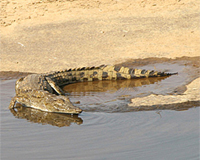
Johannesburg (AFP) Jan 21, 2009 When three rotting crocodile carcasses were spotted in a remote corner of South Africa's world famous Kruger National Park wildlife reserve, alarm bells started ringing for scientists. A quickly organised autopsy, and aerial survey, confirmed their worst fears. The giant reptiles were victims of a killer condition that had hardened their body fat to a rubber-like state, leaving them unable to move and defenceless against exposure, hunger, drowning or being eaten alive. Since the first cases were found last May, some 170 crocodiles are dead and the true death toll could be double the figure. But a team of experts are still baffled by what triggered the die-off. "It's almost incredible that we're struggling so much -- there's nothing unfortunately that's jumping out at us," said Danie Pienaar, head of scientific services at Kruger Park. Although the exact catalyst is proving elusive, the experts say the deaths are a telling sign of heavily strained water resources that flow into the park, which is home to Africa's big five: lion, leopard, elephant, buffalo and rhino. "We don't have a clear idea but the sort of the general agreement among all the researchers that it's probably the whole system that has deteriorated over time and been pushed to the brink," said Pienaar. "There's no problem that crocodiles are going to die out," he added, "but it is just a very clear signal that there is something severely wrong in our river systems. And that we cannot really afford to ignore this anymore." Kruger is South Africa's flagship wildlife park, drawing 1.3 million tourists a year and covering a landmass roughly half the size of the Netherlands. With the 110-year-old park home to some 850 non-plant species, it was feared that the infections could spread. Known as pansteatitis or "yellow fat disease", the condition is associated with eating rancid fish and has been found in commercial crocodile farms, domestic cats, birds and fresh-water turtles but is not known to affect humans. -- There was concern other species could be affected -- The condition attacks fat stores, depleting anti-oxidants and inflaming the fat in a process that scientists believe is very painful. "There was a big concern that other species could be affected," Jan Myburgh, veterinarian specialising in toxicology, told AFP. The chief worry was for lions -- seen feeding on the dead crocodiles -- and other cat species, based on the susceptibility of domestic cats, but no dead or sick felines have been found, he said. The Nile crocodiles, which average five metres (16 feet) in length and 225 kilogrammes (500 pounds), are indiscriminate eaters and well-known cannibals. To prevent further infections, park officials burnt the recovered carcasses and shot two hippopotamuses to provide easily-accessible food. "Crocodiles are opportunists, they are going to try eat any available food source," said Pienaar. "I saw a couple big crocodiles swimming with smaller crocs in their mouths." "You don't want to get to a stage where crocodiles start dying because that is the top of the food chain predator. By the time they get affected, the whole food chain below them is probably affected," Pienaar added. While dead crocodiles are no longer being found, the team of experts are still probing the die-off, which was not accompanied by mass fish kills as seen in an earlier flare-up outside park borders but farther along the same river. The Kruger deaths occurred in a remote gorge which has faced increased siltation from a dam in neighbouring Mozambique, and is fed by one of South Africa's hardest working rivers which supports various heavy industries. Clues are now being sought by a multi-pronged programme looking at the entire river system to get a better understanding of the cause and effect links around the deaths. Scientists will also attempt to reproduce the disease in a controlled experiment from mid January to understand more about how it develops in crocodiles. Meanwhile, the park and the team of experts are prepared for any further outbreak. "Everybody is on the lookout, if one crocodile dies, we'll know about it immediately," said Myburgh. Share This Article With Planet Earth
Related Links Darwin Today At TerraDaily.com
 New imaging technique is developed
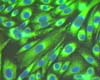 Nashville (UPI) Jan 20, 2009
 U.S. scientists say they have developed a technique that uses a scanning transmission electron microscope to "see" whole cells in liquid. |
|
|

| The content herein, unless otherwise known to be public domain, are Copyright 1995-2007 - SpaceDaily.AFP and UPI Wire Stories are copyright Agence France-Presse and United Press International. ESA Portal Reports are copyright European Space Agency. All NASA sourced material is public domain. Additional copyrights may apply in whole or part to other bona fide parties. Advertising does not imply endorsement,agreement or approval of any opinions, statements or information provided by SpaceDaily on any Web page published or hosted by SpaceDaily. Privacy Statement |
 del.icio.us
 Digg
Digg Reddit
 YahooMyWeb
 Google
 Facebook