
 |
 |
 |
 |
 |
 |
 |
 |
 |

 |

Lund, Sweden (SPX) May 04, 2011 Fossil - just stone? No, a research team in Lund, Sweden, has discovered primary biological matter in a fossil of an extinct varanoid lizard (a mosasaur) that inhabited marine environments during Late Cretaceous times. Using state-of-the-art technology, the scientists have been able to link proteinaceous molecules to bone matrix fibres isolated from a 70-million-year-old fossil; i.e., they have found genuine remains of an extinct animal entombed in stone. With their discovery, the scientists Johan Lindgren, Per Uvdal, Anders Engdahl, and colleagues have demonstrated that remains of type I collagen, a structural protein, are retained in a mosasaur fossil. The scientists have used synchrotron radiation-based infrared microspectroscopy at MAX-lab in Lund, southern Sweden, to show that amino acid containing matter remains in fibrous tissues obtained from a mosasaur bone. Previously, other research teams have identified collagen-derived peptides in dinosaur fossils based on, for example, mass spectrometric analyses of whole bone extracts. The present study provides compelling evidence to suggest that the biomolecules recovered are primary and not contaminants from recent bacterial biofilms or collagen-like proteins. Moreover, the discovery demonstrates that the preservation of primary soft tissues and endogenous biomolecules is not limited to large-sized bones buried in fluvial sandstone environments, but also occurs in relatively small-sized skeletal elements deposited in marine sediments. A paper reporting the discovery, Microspectroscopic Evidence of Cretaceous Bone Proteins is now available in the scientific journal PLoS ONE. Mosasaurs were a group of extinct varanoid lizards that inhabited marine environments during the Late Cretaceous (approximately 100-65 million year ago). The scientists have applied a broad spectrum of sophisticated techniques to achieve their results. In addition to synchrotron radiation-based infrared microspectroscopy, mass spectrometry and amino acid analysis have been performed. Virtually all experiments have been made in Lund. At MAX-lab, the experiments have been conducted at the MAX I ring, beamline 73.
Share This Article With Planet Earth
Related Links Lund University Explore The Early Earth at TerraDaily.com

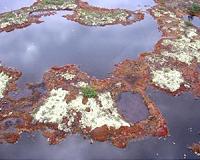 Lichen evolved on 2 tracks, like marsupials and mammals
Durham NC (SPX) May 03, 2011 Lichen, those drab, fuzzy growths found on rocks and trees, aren't as cuddly and charismatic as kangaroos or intriguing as opossums, but they could be a fungal equivalent, at least evolutionarily. A Duke research team has found that lichen that seem identical in all outward appearances and produce the same internal chemicals are in fact two different species, one living in North America an ... read more |
|
|
| The content herein, unless otherwise known to be public domain, are Copyright 1995-2010 - SpaceDaily. AFP and UPI Wire Stories are copyright Agence France-Presse and United Press International. ESA Portal Reports are copyright European Space Agency. All NASA sourced material is public domain. Additional copyrights may apply in whole or part to other bona fide parties. Advertising does not imply endorsement,agreement or approval of any opinions, statements or information provided by SpaceDaily on any Web page published or hosted by SpaceDaily. Privacy Statement |


 del.icio.us
 Digg
Digg Reddit
 YahooMyWeb
 Google
 Facebook


