
 |
 |
 |
 |
 |
 |
 |
 |
 |

 |

Tallinn (AFP) Dec 1, 2010 High-tech firms across the globe have been hit hard by China's slashing of rare earth metals exports but it is turning out to be good news for Estonia's small Silmet factory. "Unless China will change the quota, the prices of rare earth metals will at least double for next year," Silmet CEO David O'Brock told AFP. "We have never been able to keep up with demand. New inquiries are coming from all parts of the world," O'Brock added. Blackberrys, Apple iPods as well as hybrid auto motors, wind energy turbines, radar and missile systems are among the multitude of high-tech products that require small but indispensable amounts of the seventeen rare earth elements. China controls up to 97 percent of global rare earths production which totalled 124,000 tonnes in 2009, according to Commerzbank expert Daniel Briesemann. In recent years, Beijing has radically cut back rare earth metals exports resulting in rocketing prices for elements such as lanthanum, cerium, praseodymium or neodymium. Further cuts may come in 2011 and Beijing is also planning to consolidate the number of rare earths producers to just 20 by 2015, thus concentrating market power on the supply side, according to Briesemann. "At best, excess demand will lead only to soaring prices. At worst, shortages may be in the offing" in the years to come, the Commerzbank expert observed. The Silmet factory, located in the remote north-eastern Estonian town of Sillamae, produces 3,000 metric tonnes of rare earths per year, or roughly two percent of annual global supplies. The remaining one percent of supplies are drawn from stockpiles in the United States, with additional small amounts from Australia, according to Breisemann. Serving 15 rare earths customers mostly in the automotive, glass, ceramic additives and fuel catalyst market, Silmet says it is scrambling to supply them through the crisis created by Beijing. In the 1990's, China managed to undercut other global producers with cheap labour and weak environmental policies causing the closure of rare earths mines elsewhere in the world. According to O'Brock, the Silmet facility was able to survive due to its production of two non-rare earths metals, namely tantalum used in electronic components and niobium used in alloys to strengthen steel. The diversification allowed it to survive "the sometimes violent roller coaster of the rare earth market." "While all the other producers outside of Asia closed up shop for one reason or another, we were able to use our diverse portfolio of products in Estonia to keep the factory running," O'Brock said of the factory, a top secret site during Soviet times producing uranium. Silmet currently imports ores for processing from Russia, he added. "We are currently working below capacity; the bottleneck is at the mine. We are encouraging our mining partner to increase their production while also looking for additional options to cooperate with projects outside of China," said the Silmet CEO. As Commerzbank's Daniel Briesemann explained the term "rare earth" is somewhat of a misnomer as the seventeen elements "are not rare at all." Worldwide known reserves would be sufficient for 800 years of current production, he said, but rare earth metals are difficult and costly to extract and separate. China cornered the lucrative market with extraction know-how, production capacities as well as production and distribution channels, Briesemann noted. "Don't forget China also benefits from fairly lax environment and workplace safety regulations and low labour costs. So they definitely have a comparative advantage on the cost side," he said. Projecting demand to increase to 190,000 tonnes in 2014, Commerzbank forecasts supply will rise to 170,000 tonnes, leaving a 20,000-tonne deficit of rare earth metals. Few projects are in the offing globally to meet that gap. "The next meaningful supply coming onto the market will be from Australia from Lynas Corp will be on the market in 2012 followed by Molycorp in the US in 2013 with about 20,000 metric tonnes each annually but at present it is not clear if they still can hold to their start-up date."
Share This Article With Planet Earth
Related Links Space Technology News - Applications and Research

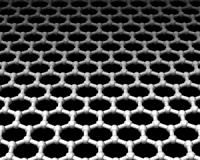 Columbia Engineering Team Discovers Graphene Weakness
New York NY (SPX) Dec 01, 2010 In 2008, experiments at The Fu Foundation School of Engineering and Applied Science at Columbia University established pure graphene, a single layer of graphite only one atom thick, as the strongest material known to mankind. This raised a question for Chris Marianetti, Assistant Professor in Columbia Engineering's Department of Applied Physics and Applied Mathematics: how and why does gra ... read more |
|
|
| The content herein, unless otherwise known to be public domain, are Copyright 1995-2010 - SpaceDaily. AFP and UPI Wire Stories are copyright Agence France-Presse and United Press International. ESA Portal Reports are copyright European Space Agency. All NASA sourced material is public domain. Additional copyrights may apply in whole or part to other bona fide parties. Advertising does not imply endorsement,agreement or approval of any opinions, statements or information provided by SpaceDaily on any Web page published or hosted by SpaceDaily. Privacy Statement |


 del.icio.us
 Digg
Digg Reddit
 YahooMyWeb
 Google
 Facebook


