|
 |
 |
 |
 |
 |
 |
 |
 |

 |
Europe takes 2-bln-dollar gamble with space freighter
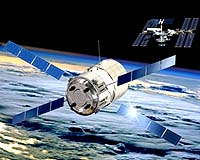
Paris (AFP) March 6, 2008 The most advanced robot freighter in space history is due for its maiden launch this weekend, crowning Europe's involvement in the troubled International Space Station (ISS). If all goes well, a beefed-up Ariane 5 rocket will blast off from French Guiana at 0339 GMT on Sunday, taking aloft a cylindrical craft the size of a London double-decker bus that will play a unique dual role of cargo ship and tug. Some two weeks later, the Automated Transfer Vehicle (ATV) will rendezvous automatically with the ISS, hauling up 7.5 tonnes of food, water, pressurised air, fuel, clothing and treats to mankind's outpost in space. After docking, it will also use its engines to propel the ISS, which is being gently plucked earthwards by terrestrial gravity and lingering atmospheric molecules, to a safer height in low orbit. After six months or so, the craft will detach from the ISS, taking with it rubbish accumulated during the station's mission. The trash and freighter will then safely disintegrate over the Pacific, mission scientists say. Weighing 11 tonnes unloaded, 10.3 metres (33.5 feet) long and 4.5 metres (16.25 feet) wide, the ATV "is the biggest and most complex space vehicle that Europe has ever built," said senior ESA official Jean-Michel Bois at mission control in Toulouse, France. Operations will be monitored round the clock by a 130-member Toulouse team, liaising with US and Russian space centres in Houston and Moscow. The ATV cannot take humans, only freight, but adds an important transport element to the ISS programme. Until now, the ISS has been supplied by the Soviet-era Progress unmanned supply ship, and by manned Soyuz and US space shuttle flights. To get this far has taken the European Space Agency (ESA) 11 years of development, including a four-year deployment delay, and a bill of 1.3 billion euros (1.96 billion dollars), more than twice the sum initially budgeted. The first ATV has been named after Jules Verne, the French author who pioneered science fiction. Four more are in the works, with their assembly and launch each costing just over 300 million euros (450 million dollars). Europe's other major contribution to the ISS has been a 1.4-billion-euro (2.11-billion-dollar) science module which has only just been delivered to the station. The ISS's construction programme was badly affected by the loss of the shuttle Columbia in February 2003. The huge cost overruns have spurred a fierce debate among European scientists. Many argue the price of getting involved in the US-led ISS has been literally astronomical and siphoned funds away from less prestigious schemes that would have yielded more science. The ATV's defenders say the investment has yielded new optical navigation, smart communications and software system to enable the craft to dock with millimetric precision without a human hand. "Europe is acquiring docking and assembly ability in space," said Bois, noting that future spaceships heading for the Moon and Mars will comprise units launched one at a time from Earth and then assembled in orbit. Community Email This Article Comment On This Article Related Links The latest information about the Commercial Satellite Industry
 Jules Verne ATV Launch Rescheduled To 9th March
 Paris, France (SPX) Mar 04, 2008
Arianespace and the European Space Agency confirm today that the launch of Jules Verne, the first Automated Transfer Vehicle, is delayed 24 hours due to a technical concern about the ATV/Ariane 5 launcher separation system. |
|
|

| The content herein, unless otherwise known to be public domain, are Copyright 1995-2007 - SpaceDaily.AFP and UPI Wire Stories are copyright Agence France-Presse and United Press International. ESA Portal Reports are copyright European Space Agency. All NASA sourced material is public domain. Additional copyrights may apply in whole or part to other bona fide parties. Advertising does not imply endorsement,agreement or approval of any opinions, statements or information provided by SpaceDaily on any Web page published or hosted by SpaceDaily. Privacy Statement |