
 |
 |
 |
 |
 |
 |
 |
 |
 |

 |
Evidence Appears To Show How And Where Frontal Lobe Works
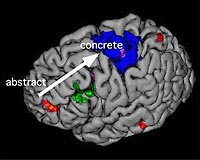
Providence RI (SPX) Mar 05, 2009 A Brown University study of stroke victims has produced evidence that the frontal lobe of the human brain controls decision-making along a continuum from abstract to concrete, from front to back. Abstract actions can be controlled at an abstract level, such as deciding to make a sandwich, or at more concrete and specific levels, such as choosing a sequence of movements that make the sandwich. The scientific data supports preexisting theories that abstract decisions about action take place in the front of the frontal lobe, the back portion controls the capacity for concrete decisions, and the progression from front to back forms a gradient from abstract to concrete. The Brown researchers are among the first to show that specific areas of the frontal cortex are needed for different levels of abstract decision. The finding, to be detailed March 1 in the journal Nature Neuroscience, represents a huge leap in comprehending how the brain supports higher level cognition and intelligent behavior. It could lead to advances in everything from the treatment of strokes to understanding how humans develop thought. Researchers from the University of California-Berkeley also participated in the study. "It is among the strongest evidence to date for a systemic organization of the frontal cortex," said lead author David Badre, an assistant professor of cognitive and linguistic sciences at Brown University. The frontal cortex of brain has been long known to affect the internal control of behavior. It controls the capacity to plan, reason, conduct higher-level thinking and connect what we know about the world to how we behave. Badre and his collaborators came to their conclusion by studying stroke victims who suffered damage to different parts of the frontal lobe. The patients all suffered a stroke at least six months prior to testing. All were screened with an MRI or CT scan to determine where any lesions existed in the brain post-stroke. The scientists recruited 11 patients - seven men and four women, ranging from age 45 to 73. A 12th patient was recruited but could not perform any of the tests involved. Researchers gave the patients four different tests that ultimately required selecting a finger-press response. For example, the first test would show a color such as red, which required an index finger push. Blue would trigger the middle finger. The test would then become more difficult by adding more alternate finger presses. Patients faced greater challenges in selecting a response as subsequent, progressive tests became more complex, with more abstract options. Badre and colleagues found that damage at a given location affected more abstract decisions but left intact the capacity for more concrete decisions. "If there is damage in a given spot, it will affect all higher (decision-making) functions but not lower functions," Badre said. The National Institutes of Health, Veterans Administration Research Service and a National Research Service Award supported the research. Share This Article With Planet Earth
Related Links Brown University All About Human Beings and How We Got To Be Here
 Chilli Peppers Continue To Help Unravel Mechanism Of Pain Sensation
 Buffalo NY (SPX) Mar 04, 2009
Capsaicin, the active ingredient in chili peppers, generally is viewed as an irritant that produces a burning sensation when applied to a sensitive area of the body, such as the cornea. |
|
|

| The content herein, unless otherwise known to be public domain, are Copyright 1995-2007 - SpaceDaily.AFP and UPI Wire Stories are copyright Agence France-Presse and United Press International. ESA Portal Reports are copyright European Space Agency. All NASA sourced material is public domain. Additional copyrights may apply in whole or part to other bona fide parties. Advertising does not imply endorsement,agreement or approval of any opinions, statements or information provided by SpaceDaily on any Web page published or hosted by SpaceDaily. Privacy Statement |
 del.icio.us
 Digg
Digg Reddit
 YahooMyWeb
 Google
 Facebook