
 |
 |
 |
 |
 |
 |
 |
 |
 |

 |

Houston TX (SPX) Apr 11, 2011 Some people collect stamps and coins, but when it comes to sheer utility, few collections rival the usefulness of Rice University researcher Michael Deem's collection of 2.6 million zeolite structures. Zeolites are materials - including some natural minerals - that act as molecular sieves, thanks to a Swiss-cheese-like arrangement of pores that can sort, filter, trap and chemically process everything from drugs and petroleum to nuclear waste. Zeolites are particularly useful as catalysts - materials that spur chemical reactions. There are about 50 naturally occurring zeolites and almost three times as many man-made varieties. Deem's database, which is described in a new paper that will be featured on the cover of an upcoming issue of the Royal Society of Chemistry's journal Physical Chemistry Chemical Physics, hints at the untapped possibilities for making even more synthetic zeolites. "For many catalytic applications only a single material has been found," said Deem, the John W. Cox Professor in Biochemical and Genetic Engineering and professor of physics and astronomy. "Expanding the diversity of the zeolite structures would be helpful to improve performance in existing applications, to explore novel functions and to answer basic scientific questions." Zeolites are useful because of the particular way atoms are mixed and arranged in their porous interiors. Based on these arrangements, zeolites can cause chemicals to react in particular ways, and even subtle changes in the arrangements can alter the reactions that are spurred. Deem's database was created to explore the many zeolite structures that are physically possible, and he said several researchers are already using the information to identify zeolites that could be used for carbon sequestration and other applications. "Computational methods can play a stimulatory role in the synthesis of new zeolite materials," Deem said. "That is the motivation; that is the challenge that brings us back to zeolites time and again." In 2007, Deem and his students used both supercomputers and unused computing cycles from more than 4,300 idling desktop PCs to painstakingly calculate every conceivable atomic formulation for zeolites. They created a database of more than 3.4 million atomic formulations of the porous silicate minerals. In the current study, Deem, Rice graduate student Ramdas Pophale and Purdue University computational analyst Phillip Cheeseman designed tools to examine and compare the physical properties of each entry. Using these tools, they pared down the larger set by removing potential redundancies as well as "low-energy" structures that would either be unstable or impossible to synthesize. For each of the 2.6 million remaining structures in the database, the team carried out calculations to find specific physical and chemical properties - including X-ray diffraction patterns, ring-size distributions and dielectric constants - that could help guide researchers interested in synthesizing them or in finding a new type of zeolite for a specific application. Deem said the new database has been deposited in the publicly available Predicted Crystallography Open Database.
Share This Article With Planet Earth
Related Links Rice University Powering The World in the 21st Century at Energy-Daily.com

 Testing Smart Energy Systems
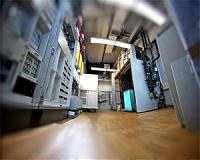
Bonn, Germany (SPX) Apr 08, 2011 The residential housing sector needs smart energy systems. And yet the potential for developing these kinds of systems remains largely untapped. In the SmartEnergyLab - an innovative test laboratory - Fraunhofer researchers are able to analyze, assess and develop almost any energy management system for controlling power and heat. A smartphone is all it takes to turn the heating on or off a ... read more |
|
|
| The content herein, unless otherwise known to be public domain, are Copyright 1995-2010 - SpaceDaily. AFP and UPI Wire Stories are copyright Agence France-Presse and United Press International. ESA Portal Reports are copyright European Space Agency. All NASA sourced material is public domain. Additional copyrights may apply in whole or part to other bona fide parties. Advertising does not imply endorsement,agreement or approval of any opinions, statements or information provided by SpaceDaily on any Web page published or hosted by SpaceDaily. Privacy Statement |


 del.icio.us
 Digg
Digg Reddit
 YahooMyWeb
 Google
 Facebook


