
 |
 |
 |
 |
 |
 |
 |
 |
 |

 |

Warwick, UK (SPX) May 27, 2011 An international team of UK and US astronomers have spotted the most distant explosion, and possibly the most distant object, ever seen in the Universe. University of Warwick astronomer Dr. Andrew Levan was one of the first members of that team to spot the exploding star, known as a gamma-ray burst (GRB), which was briefly as bright as several thousand galaxies (more than a million million times the brightness of the Sun). This very bright explosion allowed it to be detected at an extreme estimated distance of 13.14 billion light years - putting it 96% of the way to the edge of Universe and making it most distant object ever seen. The gamma-ray burst was first detected by NASA's Swift satellite in April 2009. The research team spent two years carrying out a careful examination of their data to see if the burst really was a record-breaker. "The more we examined this burst, the better it looked." says Dr. Andrew Levan. Thanks to their extreme brightness, gamma-ray bursts can be detected by Swift and other satellite observatories even when they occur at distances of billions of light years. While the bursts themselves last for minutes at most, their fading "afterglow" light remains observable with large telescopes for days or even weeks. By performing a sophisticated analysis of this light, the research team were able to show that the burst most likely has a redshift (the means astronomers use to measure distance) of approximately 9.4. While there is some uncertainty due to the faintness of the source, this is significantly greater than the previous record holding GRB, which had a redshift of 8.2. Dr. Andrew Levan of the University of Warwick, one of the first people to observe the explosion and the second author of the paper, said: "The race to find distant objects stems from the desire to find and study the first stars and galaxies that formed in the Universe, in the first few hundred million years after the Big Bang. "By looking very far away, because the light takes so long on its journey to reach the Earth, astronomers are effectively able to look back in time to this early era. Unfortunately, the immense distances involved make this very challenging. There are different ways of finding such objects, looking at distant galaxies being the most obvious, but because galaxies are faint it is very difficult. GRB afterglows are so much brighter". The researchers used the Swift satellite, the Gemini North Observatory, and the Hubble Space Telescope. "This GRB shows us that there is a lot of action going on in the Universe which we can't currently see," Said Professor Nial Tanvir, from the University of Leicester and the leader of the Hubble Space Telescope part this research program, "Our observations show us that even the Hubble Space Telescope is only seeing the tip of the iceberg in the distant Universe". Swift is capable of finding some GRBs at distances corresponding to when the first stars are predicted in the Universe", said Prof. Paul O'Brien a member of the Swift team at Leicester. The research has been accepted for publication in the Astrophysical Journal in a paper entitled "Photometric Redshift of z ~ 9.4 for GRB 090429B. 2011" with former Penn State graduate student Antonino Cucchiara as first author and Dr. Andrew Levan from the University of Warwick as its second author.
Share This Article With Planet Earth
Related Links University of Warwick Stellar Chemistry, The Universe And All Within It

 Nearby Supernova Factory Ramps Up
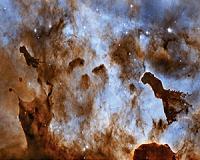
Boston MA (SPX) May 25, 2011 A local supernova factory has recently started production, according to a wealth of new data from NASA's Chandra X-ray Observatory on the Carina Nebula. This discovery may help astronomers better understand how some of the Galaxy's heaviest and youngest stars race through their lives and release newly-forged elements into their surroundings. Located in the Sagittarius-Carina arm of the Mil ... read more |
|
|
| The content herein, unless otherwise known to be public domain, are Copyright 1995-2010 - SpaceDaily. AFP and UPI Wire Stories are copyright Agence France-Presse and United Press International. ESA Portal Reports are copyright European Space Agency. All NASA sourced material is public domain. Additional copyrights may apply in whole or part to other bona fide parties. Advertising does not imply endorsement,agreement or approval of any opinions, statements or information provided by SpaceDaily on any Web page published or hosted by SpaceDaily. Privacy Statement |


 del.icio.us
 Digg
Digg Reddit
 YahooMyWeb
 Google
 Facebook


