|
 |
 |
 |
 |
 |
 |
 |
 |

 |
Falcon Investigates Pollution From The Dakar Metropolis Into Desert Dust Layers
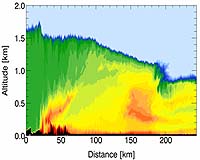
Oberpfaffenhofen, Germany (SPX) Feb 27, 2008 The German Aerospace Centre (DLR) have been measuring Saharan desert dust as part of the Saharan Mineral Dust Experiment SAMUM, funded by the German researchers from the Deutsche Forschungsgemeinschaft. The measurements used the DLR research aircraft Falcon operating from the Cape Verde Islands. On 29 January, scientists from the DLR Institute of Atmospheric Physics conducted a very successful research flight focusing on the entrainment of urban pollution from the city of Dakar into desert dust layers above the city. Dakar is the capital of Senegal with an area of 550 square kilometres and a population of more than 2.5 million residents. Falcon traversed Dakar at high altitude to measure vertical profiles of aerosol particles and water vapour in the urban plume by means of an airborne lidar system (the WALES demonstrator instrument). In a second flight sequence, Falcon crossed the Dakar area at very low altitude (below 1 km) to sample the polluted air with all the instruments operated onboard the aircraft. After stopover and refuelling at Dakar International Airport, the team onboard the aircraft studied the mixing and processing of urban pollution and desert dust during atmospheric transport out on the Atlantic Ocean. During the entire study, Dakar was covered by a dense dust layer of 1.5 km thickness. The experiment provides important information on the impact of large cities on Earth's climate. The Dakar case study will serve as a master copy for future experiments on climate effects of potential megacities in arid environments. Community Email This Article Comment On This Article Related Links DLR Institute of Atmospheric Physics Earth Observation News - Suppiliers, Technology and Application
 NASA Extends Mission For Ball Aerospace-Built ICESat
 Boulder CO (SPX) Feb 21, 2008
The Ice, Cloud and Land Satellite (ICESat) built by Ball Aerospace and Technologies Corp. will continue operations until at least 2010 following a NASA mission extension contract. ICESat, designed for a three-year lifetime with a five-year goal, was launched Jan. 12, 2003. The Ball Commercial Platform (BCP) 2000 employed for ICESat was built under contract to NASA's Rapid Space Development Office (RSDO). |
|
|
| The content herein, unless otherwise known to be public domain, are Copyright Space.TV Corporation. AFP and UPI Wire Stories are copyright Agence France-Presse and United Press International. ESA Portal Reports are copyright European Space Agency. All NASA sourced material is public domain. Additional copyrights may apply in whole or part to other bona fide parties. Advertising does not imply endorsement, agreement or approval of any opinions, statements or information provided by Space.TV Corp on any Web page published or hosted by Space.TV Corp. Privacy Statement |