
 |
 |
 |
 |
 |
 |
 |
 |
 |

 |
First Global Hawk Unmanned System For Environmental Science Research
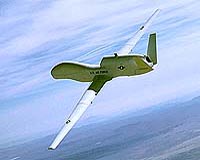
Edwards CA (SPX) Jan 21, 2009 NASA and Northrop Grumman have unveiled the first Global Hawk unmanned aircraft system (UAS) to be used for environmental science research, heralding a new application for the world's first fully autonomous high-altitude, long-endurance aircraft. NASA's Dryden Flight Research Center and Northrop Grumman are returning NASA's two Global Hawk aircraft to flight this year under a Space Act Agreement signed in May 2008. Northrop Grumman will share in use of the aircraft to conduct its own flight demonstrations for expanded markets, missions and airborne capabilities, including UAS integration into national airspace. "Today marks the debut of NASA's newest airborne science capability," said Kevin L. Petersen, director of NASA Dryden. "This Global Hawk vehicle represents the first non-military use of this remarkable unmanned aircraft system, and NASA's partnership with Northrop Grumman has made it possible." "Northrop Grumman is honored to join in this celebration of another application of Global Hawk's distinctive capabilities, which make it well suited for many airborne science applications," said Gary Ervin, corporate vice president and president of Northrop Grumman's Aerospace Systems sector. "Global Hawk provides a reliable, cost-effective and efficient platform for NASA's science missions and gives the nation an important ability to monitor and understand global climate change." The two NASA Global Hawk aircraft, among the first seven built in the original Advanced Concept Technology Demonstration program sponsored by the Defense Advanced Research Projects Agency, were transferred to NASA Dryden by the U.S. Air Force in 2007. NASA announced plans to use them for missions supporting its Science Mission Directorate and the Earth science community that require high-altitude, long-endurance, long-distance airborne capability. The NASA Global Hawk's initial Earth science mission will be Global Hawk Pacific 2009, or GLOPAC. This campaign will consist of six long-duration missions over the Pacific and Arctic regions in the late spring and early summer of 2009. Twelve NASA and NOAA scientific instruments integrated into one of the NASA Global Hawk aircraft will collect atmospheric data while flying through the upper troposphere and lower stratosphere. Global Hawk can fly at altitudes up to 65,000 feet for more than 31 hours at a time. Global Hawk is supporting the Air Force in the global war on terrorism, providing persistent intelligence, surveillance and reconnaissance to warfighters. To date, Global Hawks have flown more than 28,000 hours. Global Hawk has many potential applications for the advancement of science, improvement of hurricane monitoring techniques, development of disaster support capabilities, and development of advanced UAS technologies. For example, Global Hawks were used to help monitor wildfires in California and for hurricane relief efforts along the Gulf Coast. The Dryden Flight Research Center, located on Edwards Air Force Base in the high desert of Southern California, is NASA's primary installation for atmospheric flight research. It has supported NASA's technology development efforts in aeronautics, environmental science, space exploration and space operations for more than 60 years. Share This Article With Planet Earth
Related Links Northrop Grumman Earth Observation News - Suppiliers, Technology and Application
 Landmark Year Ahead For Earth Observation Science Missions
 Paris, France (ESA) Jan 20, 2009
With three Earth Explorer satellites set to launch this year, another three under construction and up to three more about to be selected for feasibility study, 2009 promises to be a significant year for ESA's contribution to Earth science - paving the way to a clearer understanding of how our planet works. |
|
|

| The content herein, unless otherwise known to be public domain, are Copyright 1995-2007 - SpaceDaily.AFP and UPI Wire Stories are copyright Agence France-Presse and United Press International. ESA Portal Reports are copyright European Space Agency. All NASA sourced material is public domain. Additional copyrights may apply in whole or part to other bona fide parties. Advertising does not imply endorsement,agreement or approval of any opinions, statements or information provided by SpaceDaily on any Web page published or hosted by SpaceDaily. Privacy Statement |
 del.icio.us
 Digg
Digg Reddit
 YahooMyWeb
 Google
 Facebook