
 |
 |
 |
 |
 |
 |
 |
 |
 |

 |
First Lab Experiment To Accurately Model Stellar Jets Explains Mysterious Knots
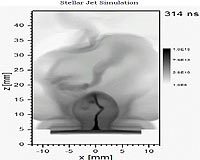
Rochester NY (SPX) Feb 11, 2009 Some of the most breathtaking objects in the cosmos are the jets of matter streaming out of stars, but astrophysicists have long been at a loss to explain how these jets achieve their varied shapes. Now, laboratory research detailed in the current issue of Astrophysical Review Letters shows how magnetic forces shape these stellar jets. "The predominant theory says that jets are essentially fire hoses that shoot out matter in a steady stream, and the stream breaks up as it collides with gas and dust in space-but that doesn't appear to be so after all," says Adam Frank, professor of astrophysics at the University of Rochester, and co-author of the paper. "These experiments are part of an unusal international collaboration of plasma physicists, astronomers and computational scientists. It's a whole new way of doing astrophysics. The experiments strongly suggest that the jets are fired out more like bullets or buckshot. They don't break into pieces-they are formed in pieces." Frank says the experiment, conducted by Professor Sergey Lebedev's team in the Deparent of Physics at Imperial College London, may be the best astrophysical experiment that's ever been done. Replicating the physics of a star in a laboratory is exceptionally difficult, he says, but the Imperial experiment matches the known physics of stellar jets surprisingly well. "Lebedev's group at Imperial has absolutely pioneered the use of these experiments for studying astrophysical phenomena. The collaboration between Imperial and Rochester has been going on for almost 5 years and now it is bearing some extraordinary fruit." At Imperial, Lebedev sent a high-powered pulse of energy into an aluminum disk. In less than a few billions of a second, the aluminum began to evaporate, creating a cloud of plasma very similar to the plasma cloud surrounding a young star. Where the energy flowed into the center of the disk, the aluminum eroded completely, creating a hole through which a magnetic field from beneath the disk could penetrate." The field initially pushes aside the plasma, forming a bubble within it, says Frank, who carried out the astrophysical analysis of the experiment. As the field penetrates further and the bubble grows, however, the magnetic fields begin to warp and twist, creating a knot in the jet. Almost immediately, a new magnetic bubble forms inside the base of the first as the first is propelled away, and the process repeats. Frank likens the magnetic fields' affect on the jet to a rubber band tightly wrapped around a tube of toothpaste-the field holds the jet together, but it also pinches the jet into bulges as it does. "We can see these beautiful jets in space, but we have no way to see what the magnetic fields look like," says Frank. "I can't go out and stick probes in a star, but here we can get some idea-and it looks like the field is a weird, tangled mess." Frank says other aspects of the experiment, such as the way in which the jets radiatively cool the plasma in the same way jets radiatively cool their parent stars, make the series of experiments an important tool for studying stellar jets. With this new model, he says, astrophysicists do not have to assume that the knotted jets they see in nature mean some unknown phenomenon interrupted the jets' flow of material. Now, says Frank, some experiments that were once far beyond astrophysicists' reach have been, literally, brought down to Earth. Share This Article With Planet Earth
Related Links University of Rochester Stellar Chemistry, The Universe And All Within It
 Astronomers Spot Cosmic Dust Fountain
 Chicago IL (SPX) Feb 10, 2009
Space dust annoys astronomers just as much as the household variety when it interferes with their observations of distant stars. And yet space dust also poses one of the great mysteries of astronomy. |
|
|

| The content herein, unless otherwise known to be public domain, are Copyright 1995-2007 - SpaceDaily.AFP and UPI Wire Stories are copyright Agence France-Presse and United Press International. ESA Portal Reports are copyright European Space Agency. All NASA sourced material is public domain. Additional copyrights may apply in whole or part to other bona fide parties. Advertising does not imply endorsement,agreement or approval of any opinions, statements or information provided by SpaceDaily on any Web page published or hosted by SpaceDaily. Privacy Statement |
 del.icio.us
 Digg
Digg Reddit
 YahooMyWeb
 Google
 Facebook