
 |
 |
 |
 |
 |
 |
 |
 |
 |

 |
First Light Curve Analysis Of 20 Eclipsing Binaries With Integral OMC
Paris, France (ESA) Jan 20, 2009 Photometric data gathered by Integral's Optical Monitoring Camera (OMC) has been used to study selected eclipsing binary stars for which the light curve had hitherto not been analyzed. This recent study by Petr Zasche from the Astronomical Institute in Prague provides new key information on the basic properties of these binary systems - properties that were previously not known or only estimated with low precision. The Integral spacecraft is equipped with instruments dedicated to observe the high energy (3 keV to 10 MeV) Universe. It also performs simultaneous observations in the optical (500-600 nm, Johnson V band) with the Optical Monitoring Camera. The OMC not only targets the objects observed simultaneously by the two gamma-ray instruments and the X-ray monitor, but also observes serendipitous objects in its field of view. In a paper to appear in the February 2009 issue of New Astronomy, Zasche presents results from a study of twenty eclipsing binaries - binary star systems in which the two orbiting stars regularly pass in front of each other as seen from Earth. The study is based on data from serendipitous observations stored in the OMC archive (see Editor's notes).
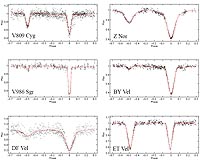
The advantage of the OMC This is particularly useful for binary systems with an orbital period of a few days - these require long observation times in order to be able to determine the entire light curve. Selection and light curve analysis The twenty binary systems in this study were selected on the basis that their light curves had not been analysed before, and that they had a large number of OMC data points. Using the OMC photometric data, Zasche performed the first analysis of the folded light curves for these binary systems. Figure 1 shows the folded light curve for six of the eclipsing binaries in this study. Analysis of the folded light curves yielded several orbital parameters of these binary star systems including the orbital period and the inclination of the orbits relative to the line of sight. In addition, a number of other basic properties such as the relative contribution of each star to the total luminosity, the relative sizes of the two stars and the ratio of the masses of the two stars were also derived. The deepest minimum in the light curve was defined to correspond with the eclipse of the primary star by the secondary star.
Study results and future work One binary system (ET Vel) was found to have an eccentric orbit with e=0.0737. For ten systems the radius of the secondary star is found to be larger than that of the primary star. In five of the binary systems there is indication of a possible third component. Based on serendipitous OMC data, this study has provided the first set of orbital and physical parameters for this sub-set of eclipsing binary systems. The results of this study have also confirmed the previously determined orbital periods. Further improvements and determination of the absolute values rather than the relative values of the physical properties will require spectroscopic studies and observations at different wavelengths. Zasche, P. et al. [2009] preprint Share This Article With Planet Earth
Related Links Integral Stellar Chemistry, The Universe And All Within It
 Dust Detected Around Primitive Star Sheds New Light On Cosmic Origins
 Ithaca NY (SPX) Jan 16, 2009
A Cornell-led team of astronomers has observed dust forming around a dying star in a nearby galaxy, giving a glimpse into the early universe and enlivening a debate about the origins of all cosmic dust. |
|
|

| The content herein, unless otherwise known to be public domain, are Copyright 1995-2007 - SpaceDaily.AFP and UPI Wire Stories are copyright Agence France-Presse and United Press International. ESA Portal Reports are copyright European Space Agency. All NASA sourced material is public domain. Additional copyrights may apply in whole or part to other bona fide parties. Advertising does not imply endorsement,agreement or approval of any opinions, statements or information provided by SpaceDaily on any Web page published or hosted by SpaceDaily. Privacy Statement |
 del.icio.us
 Digg
Digg Reddit
 YahooMyWeb
 Google
 Facebook