
 |
 |
 |
 |
 |
 |
 |
 |
 |

 |
First Lunar Orbit Reduction Manoeuvre Of Chandrayaan-1
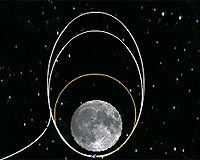
Bangalore, India (SPX) Nov 11, 2008 The first orbit reduction manoeuvre of Chandrayaan-1 spacecraft which is orbiting the moon, was successfully performed yesterday (November 9, 2008) night. As part of that manoeuvre which began at 20:03 IST, the 440 Newton liquid engine of the spacecraft was fired for about 57 seconds. With this, the nearest point of Chandrayaan-1's orbit (periselene) from the moon's surface was reduced from 504 km to 200 km while the farthest point (aposelene) remained unchanged at 7,502 km. In this elliptical orbit, Chandrayaan-1 takes about ten and a half hours to circle the moon once. It may be recalled that the lunar orbit insertion manoeuvre of Chandrayaan-1 was successfully performed on November 8, 2008 and the spacecraft entered into an orbit around the moon with a periselene of 504 km and an aposelene of 7,502 km. The health as well as the orbit of Chandrayaan-1 spacecraft is being closely monitored from the Spacecraft Control Centre of ISRO Telemetry, Tracking and Command Network (ISTRAC) in Bangalore with crucial support from Indian Deep Space Network antennas at Byalalu. The spacecraft performance is normal. Further orbit reduction manoeuvres are scheduled in the coming days to take Chandrayaan-1 to its final operational orbit of 100 km height from the lunar surface. After this, the Moon Impact Probe, one of the eleven scientific instruments (payloads) of Chandrayaan-1, will be released to hit the moon's surface. Share This Article With Planet Earth
Related Links ISRO Mars News and Information at MarsDaily.com Lunar Dreams and more
 India's spacecraft enters lunar orbit: officials
 Bangalore, India (AFP) Nov 8, 2008
India's first unmanned spacecraft entered lunar orbit Saturday, 18 days after an Indian-built rocket transported it into outer space, officials here announced. |
|
|

| The content herein, unless otherwise known to be public domain, are Copyright 1995-2007 - SpaceDaily.AFP and UPI Wire Stories are copyright Agence France-Presse and United Press International. ESA Portal Reports are copyright European Space Agency. All NASA sourced material is public domain. Additional copyrights may apply in whole or part to other bona fide parties. Advertising does not imply endorsement,agreement or approval of any opinions, statements or information provided by SpaceDaily on any Web page published or hosted by SpaceDaily. Privacy Statement |
 del.icio.us
 Digg
Digg Reddit
 YahooMyWeb
 Google
 Facebook