
 |
 |
 |
 |
 |
 |
 |
 |
 |

 |
First round of US-Russia arms treaty talks in May
Moscow (AFP) April 27, 2009 Russian and US officials will meet in Moscow next month for the first round of negotiations to replace a Cold War-era nuclear arms control treaty, the Russian foreign ministry said Monday. The two sides "agreed to organise the first round of negotiations of the two full delegations between May 18 and May 20," the ministry said in a statement. Earlier this month US President Barack Obama and his Russian counterpart Dmitry Medvedev pledged to seek a successor agreement to the Strategic Arms Reduction Treaty (START) by the time it expires in December. The dates for the talks were set during the first official contact in Rome on Friday which aimed to pave the way for opening negotiations following instructions from the US and Russian leaders. The Russian foreign ministry said the Rome meeting took place in a "constructive atmosphere". "There was a detailed and frank exchange of views on the character of the future agreement. The main problems to be resolved at future negotiations were pointed out," the ministry statement said. US Secretary of State Hillary Clinton and her Russian counterpart Sergei Lavrov will also discuss START during a meeting in Washington on May 7 and again on May 19 in Brussels as part of the Russia-NATO talks, the US ambassador to Russia John Beyrle told Echo of Moscow radio. Negotiations on the treaty -- seen as a cornerstone of strategic arms control -- made little progress under former US president George W. Bush. Signed in 1991, START placed strict limits on the number of missiles and warheads in the US and Russian nuclear arsenals, leading to steep reductions in the nuclear arsenals of both sides. But the agreement expires on December 5 of this year. Russian officials have given out mixed signals on the country's readiness to respond to Obama's call for major arms cuts and eventually a nuclear-free world. "As the only nuclear power to have used a nuclear weapon, the United States has a moral responsibility to act," Obama said in a speech in Prague on April 5. "We cannot succeed in this endeavour alone, but we can lead it." Last Monday Medvedev stressed on a visit to Helsinki the importance of arms reduction, suggesting both Moscow and Washington could cut their weapons stocks with a new treaty. "In this treaty, which should replace the START treaty, it is necessary to limit the delivery systems of the nuclear warheads and not only the quantity of warheads themselves -- taking into account intercontinental ballistic missiles, and submarine-based ballistic missiles and heavy bombers that carry nuclear means," he said. Medvedev said it was important to prevent the placing of strategic weapons outside national borders or in space and added that countries should not be able to build up conventional forces to compensate for cuts in nuclear ones. Last week the head of the Russian general staff, Nikolai Makarov, also said Moscow is prepared to "significantly" cut its nuclear arsenal if a deal is reached with the United States. But he added that it was important to "make careful calculations" and see whether Washington was ready to reciprocate. Share This Article With Planet Earth
Related Links Learn about nuclear weapons doctrine and defense at SpaceWar.com Learn about missile defense at SpaceWar.com All about missiles at SpaceWar.com Learn about the Superpowers of the 21st Century at SpaceWar.com
 Japan to host global meet for nuke-free world: govt
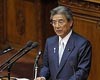 Tokyo (AFP) April 27, 2009
Japan, the only country ever hit by atomic bombs, Monday threw its weight behind US President Barack Obama's call for a nuclear-free world and pledged to host a global disarmament meeting next year. |
|
|

| The content herein, unless otherwise known to be public domain, are Copyright 1995-2007 - SpaceDaily.AFP and UPI Wire Stories are copyright Agence France-Presse and United Press International. ESA Portal Reports are copyright European Space Agency. All NASA sourced material is public domain. Additional copyrights may apply in whole or part to other bona fide parties. Advertising does not imply endorsement,agreement or approval of any opinions, statements or information provided by SpaceDaily on any Web page published or hosted by SpaceDaily. Privacy Statement |
 del.icio.us
 Digg
Digg Reddit
 YahooMyWeb
 Google
 Facebook