
 |
 |
 |
 |
 |
 |
 |
 |
 |

 |
Fossil of world's biggest snake found in Colombia
Panama City (AFP) Feb 4, 2009 Scientists have found a 60-million-year-old fossil of the world's largest snake, a 13-meter (42-foot), one-tonne behemoth dubbed Titanoboa, in a coal mine in Colombia, the US Smithsonian Tropical Research Institute said Wednesday. "The discovery of Titanoboa challenges our understanding of past climates and environments, as well as the biological limitations on the evolution of giant snakes," said Jason Head, member of the Panama-based research institute and lead author of the study to be published Thursday in Nature magazine. "This shows how much more information about the history of Earth there is to glean from a resource like the reptile fossil record," said the assistant professor of ecology and evolutionary biology at the University of Toronto Mississauga. From the size of the 1.14-tonne Titanoboa, scientists have estimated the average annual temperature in the tropical jungle it inhabited 60 million years ago at 30-34 degrees Celsius (86-93 degrees Farenheit). "This temperature estimate is much hotter than modern temperatures in tropical rainforests anywhere in the world," said Carlos Jaramillo, Smithsonian staff scientist and co-organizer of the excavations in Colombia. "That means that tropical rainforests could exist at temperatures 3-4 degrees Celsius hotter than modern tropical rainforests experience," he added, alluding to scientific theories that would have tropical forests disappear if global warming boosts temperatures by that measure in the future. The size and weight of Titanoboa -- its name is derived from its current descendant, the boa constrictor -- was determined by comparing its fossil vertebrae to the radius-to-length ratio of living snakes. The previous snake size record was held by a python that measured 10 meters (33 feet) and weighed (403 pounds), the Smithsonian said. The latest fossils were found inside the Cerrejon coal mine, in Colombia's northeastern region of Guajira. Scientists also found fossils of prehistoric crocodiles and tortoises that Titanboa may have fed on in the rain forest. Share This Article With Planet Earth
Related Links Explore The Early Earth at TerraDaily.com
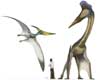
 Launching Some 500 Pounds Of Pterosaurs Took Four Legs
 Baltimore MD (SPX) Jan 14, 2009
Pterosaurs have long suffered an identity crisis. Pop culture heedlessly - and wrongly - lumps these extinct flying lizards in with dinosaurs. Even paleontologists assumed that because the creatures flew, they were birdlike in many ways, such as using only two legs to take flight. |
|
|

| The content herein, unless otherwise known to be public domain, are Copyright 1995-2007 - SpaceDaily.AFP and UPI Wire Stories are copyright Agence France-Presse and United Press International. ESA Portal Reports are copyright European Space Agency. All NASA sourced material is public domain. Additional copyrights may apply in whole or part to other bona fide parties. Advertising does not imply endorsement,agreement or approval of any opinions, statements or information provided by SpaceDaily on any Web page published or hosted by SpaceDaily. Privacy Statement |

 del.icio.us
 Digg
Digg Reddit
 YahooMyWeb
 Google
 Facebook