Energy News  
Four Launches From Esrange Space Center In Four Days

For other images of the REXUS launch please go here.
by Staff Writers
Esrange, Sweden (SPX) Mar 14, 2009
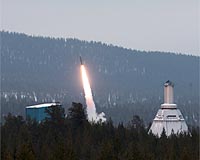
During the last four days two large scientific balloon gondolas and two rockets have been launched from Swedish Space Corporation's (SSC) facility Esrange Space Center. A fifth launch, a student rocket with the aim to break an altitude record for amateur rocketry, is scheduled for Monday.

The two balloon projects
The scientific objective of the two balloon flights was to obtain measurements of stratospheric trace gases within the arctic stratospheric polar vortex. This as part of continuing research of ozone destruction and satellite validation. The two balloon campaigns were called TWIN and MIPAS B/TELIS.

The two student rocket projects
The two rockets launched this week were part of a student programme called Rexus (Rocket Experiments for University Students). The rockets carried five scientific student experiments onboard. The Rexus programme is an annual sounding rocket program launched from the Esrange Space Center.

The record rocket Stratos
A team of 15 students from the Technical University in Delft, Holland, has developed a new amateur rocket with the aim to break the present European altitude record of 10.7 km held by the British amateur rocket society MARS.

2009 will be a busy year at Esrange Space Center. At least 17 balloon launches and four rocket launches remain this year.

Share This Article With Planet Earth
del.icio.usdel.icio.us DiggDigg RedditReddit
YahooMyWebYahooMyWeb GoogleGoogle FacebookFacebook


Related Links
Stratos
Rexus
MIPAS B/TELIS
Launch Pad at Space-Travel.com


Memory Foam Mattress Review
Newsletters :: SpaceDaily :: SpaceWar :: TerraDaily :: Energy Daily
XML Feeds :: Space News :: Earth News :: War News :: Solar Energy News


ILS Announces Proton Launch ViaSat-1 Satellite In 2011

Reston VA (SPX) Mar 13, 2009
International Launch Services has announced a contract for the launch of the ViaSat-1 satellite on an ILS Proton. The satellite is under construction by Space Systems Loral and is scheduled to launch in the first half of 2011 from the Baikonur Cosmodrome in Kazakhstan.


  • ACCCE Commends Western Governors For Supporting Clean Coal Technologies
  • Broadband Wireless Research Gets Green Light
  • Revealing New Apps For Carbon Nanomaterials In Hydrogen Storage
  • MIT Battery Material Could Lead To Rapid Recharging Of Many Devices

  • Analysis: Nuke waste problem unsolved
  • Analysis: Turkey's energy future
  • France may allow Gulf investors into nuclear giant: FT
  • Vattenfall, RWE, E.ON, EDF in running for Baltic nuclear plant

  • Rendezvous With HALO
  • SKoreans buy air purifiers amid "yellow dust" warning
  • More Reasons To Hate Humidity
  • Scientist Models The Mysterious Travels Of Greenhouse Gas

  • Prince Charles in Brazil to deliver eco-warning
  • Prince Charles pushes eco-agenda in Latin America
  • Danger Lurks Underground For Oak Seedlings
  • World Bank approves 1.3 bln dlrs for Brazilian eco projects

  • Lowly maggot poised to boost income, cut pollution
  • Seed germination control process revealed
  • Liberia invaded by crop-eating caterpillars again: ministry
  • Farmers Saving The Economy Again, But For How Long

  • Sweden to slash 'clean' car taxes, hike diesel price
  • China Geely boss says open to overseas auto deals
  • Singapore-made biofuel to run cars in Europe, North America
  • Car makers get serious on the environment

  • Cathay Pacific lost 1.1 billion dollars in 2008
  • National hypersonic science centers named
  • First China-assembled Airbus set for June delivery: report
  • China's large passenger jet ready in eight years: report

  • Nuclear Power In Space - Part 2
  • Nuclear Power In Space
  • Outside View: Nuclear future in space

  • The content herein, unless otherwise known to be public domain, are Copyright 1995-2007 - SpaceDaily.AFP and UPI Wire Stories are copyright Agence France-Presse and United Press International. ESA Portal Reports are copyright European Space Agency. All NASA sourced material is public domain. Additional copyrights may apply in whole or part to other bona fide parties. Advertising does not imply endorsement,agreement or approval of any opinions, statements or information provided by SpaceDaily on any Web page published or hosted by SpaceDaily. Privacy Statement