
 |
 |
 |
 |
 |
 |
 |
 |
 |

 |
France's 'wild west' holds up against modernity
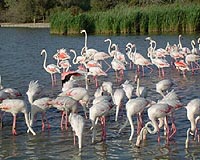
Arles, France (AFP) April 23, 2009 The Camargue, Europe's largest wetland and home to a dwindling breed of French-style "cowboys", is fighting to preserve its unique environment and identity despite the damage done by tourism and nearby industries. "In France, when people think of the Camargue, they are thinking of something which hasn't existed in centuries," said Patrick Grillas, a local environmentalist. "They think of wild nature, with wild horses, wild bulls. But the reality is completely different," he said. There are black bulls -- bred for meat and for a local form of bullfighting -- and white horses native to the Camargue but they have not roamed freely for many years. These beasts add to the rich history and tradition of the region, but its overriding interest is the unique ecology of this triangle of land wedged between two branches of the mighty Rhone river and the Mediterranean sea. The delta is a maze of largely empty roads, salt flats, fresh and salt water lagoons, pink flamingos, and is a major wintering spot for hundreds of thousands of migrating waterbirds. The Camargue has to fight a never-ending battle with nature -- it is under constant threat of flooding from the Rhone -- and with the workings of man in the 930 square kilometre (360 square mile) area. The area around one of its lagoons -- a haven for around 400 different types of bird -- has been protected as a regional park for decades and last year was incorporated into the larger Camargue national park But just to the east of the Camargue lies Fos-sur-Mer, one of the biggest industrial complexes in the Mediterranean basin whose factories and oil refinery pose a constant threat of pollution. And to the west is La Grande Motte, one of France's biggest beach resorts. -- That's why people come and see us -- --------------------------------------- Another danger is the winding down of many salt production facilities due to cheaper salt coming in to France from abroad, said environmentalist Grillas. "By keeping water levels high in a region that is dry in summer, they (salt producers) have created zones that are extremely favourable for waterbirds and for their reproduction," he said. If no-one steps in to maintain the dykes built by the salt companies, water levels will fall and nesting zones will dry up, he warned. The north of the Camargue is largely made of agricultural land, which is used to grow cereals, grapes and rice and is home to the famous bulls and white horses of the region. The bulls are herded by the around 40 remaining "gardians" who ride the hardy local horses to round them up for market or to take them to a "course camarguaise" in which young men try to snatch a ribbon from between a bull's horns. "It would be impossible to do this without a horse," said Jacques Bon, a sprightly 82-year-old Camargue landowner as he mounted a horse called Elegant to demonstrate his bull-herding skills. Bon, who along with his wife has set up a luxury hotel named Le Mas de Peint and a bull-ring on the land he was born on, does this just for fun these days, but he employs two full-time "gardians" to look after his herd." "Gardians" are a prominent feature in the cultural life of the Camargue, taking part in processions for saint's day celebrations as well as in the bull-running games. "That's why people come and see us," said Bon, referring to the tens of thousands of tourists who brave the region's notorious mosquitoes every summer. Share This Article With Planet Earth
Related Links Darwin Today At TerraDaily.com
 'G8-Plus' vow stronger commitments on protecting biodiversity
 Syracuse, Italy (AFP) April 23, 2009
The environment ministers of rich and emerging nations Thursday pledged new commitments to stopping biodiversity loss even with resources hit hard by the global financial crisis. |
|
|

| The content herein, unless otherwise known to be public domain, are Copyright 1995-2007 - SpaceDaily.AFP and UPI Wire Stories are copyright Agence France-Presse and United Press International. ESA Portal Reports are copyright European Space Agency. All NASA sourced material is public domain. Additional copyrights may apply in whole or part to other bona fide parties. Advertising does not imply endorsement,agreement or approval of any opinions, statements or information provided by SpaceDaily on any Web page published or hosted by SpaceDaily. Privacy Statement |
 del.icio.us
 Digg
Digg Reddit
 YahooMyWeb
 Google
 Facebook