|
 |
 |
 |
 |
 |
 |
 |
 |

 |
Fuel: No Flying Without The Good Stuff
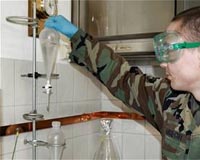
52nd Fighter Wing Public Affairs Spangdahlem AFB, Germany (AFNS) Jun 17, 2008 There are not many Airmen with two stripes who have a job that gives them the authority to halt flying operations across the entire installation. This is a responsibility Airman 1st Class Darren Albrecht does not take lightly. The 52nd Logistics Readiness Squadron fuel laboratory technician here is responsible for testing all of the Deparent of Defense and NATO fuel used on base in government aircraft and vehicles. He spends his days gathering fuel samples and running each one through a series of tests. The tests are designed to check for impurities, water, conductivity and other flaws in a room where everything from the door and radio to beakers and microscope are securely grounded. "I am responsible for making sure that all of the pilots and the aircraft have the best fuel possible," Airman Albrecht said. Ironically, his father does the same job at Tinker Air Force Base, Okla. When he enlisted in the Air Force, this was the only job that Airman Albrecht wanted. After spending six weeks at Sheppard AFB, Texas, to learn about the fuels career field, Airman Albrecht then completed a second technical school at Fort Lee Va., were he learned how to test fuel in a laboratory. Only the top Airmen are selected for the laboratory school, said Tech. Sgt. John Rowland, the 52nd LRS fuels laboratory superintendent. "Only the Airmen who perform with a high attention to detail and accuracy are qualified for this position" The fuel that comes through Airman Albrecht's laboratory is run through about 10 tests. If he finds a questionable batch of fuel, he reruns his tests. If the results are bad again, he contacts his supervisor to confirm his findings. The discovery of a bad fuel shipment would lead to a complete grounding of aircraft. Because bad fuel can lead to serious aircraft problems, this is a job that the laboratory Airmen take very seriously. "We are always out there taking samples," Sergeant Rowland said. "We have to pay a lot of attention to detail. Since we have the ability to stop operations on base, we have to be 100 percent accurate on fuel quality analysis." The biggest challenge of the job is trying not to get complacent, Airman Albrecht said. "When you are doing the same test over and over again, if you do something wrong, it could get messed up," he said. In the event of an aircraft accident, fuels technicians are one of the first responders to the scene. "We have to get a fuel sample from the plane to determine if it was the cause of the accident," Sergeant Rowland said. As a testament to their processes of testing and testing again, there has never been an aircraft accident at Spangdahlem Air Base that was caused from bad fuel, Airman Albrecht said. Community Email This Article Comment On This Article Related Links the missing link Powering The World in the 21st Century at Energy-Daily.com
 Japan, China close to gas field deal
 Tokyo (AFP) June 16, 2008
Japan said Monday it was close to reaching a deal with China on joint development of gas fields in disputed waters, the focus of a long-running spat between the two Asian giants. |
|
|
| The content herein, unless otherwise known to be public domain, are Copyright Space.TV Corporation. AFP and UPI Wire Stories are copyright Agence France-Presse and United Press International. ESA Portal Reports are copyright European Space Agency. All NASA sourced material is public domain. Additional copyrights may apply in whole or part to other bona fide parties. Advertising does not imply endorsement, agreement or approval of any opinions, statements or information provided by Space.TV Corp on any Web page published or hosted by Space.TV Corp. Privacy Statement |