
 |
 |
 |
 |
 |
 |
 |
 |
 |

 |
Fuelling Of The Planck Spacecraft
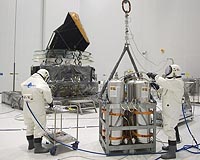
Kourou, French Guiana (ESA) Apr 23, 2009 Fuelling operations for the Planck spacecraft have been successfully completed last week. The filling of the propellant tanks with hydrazine liquid was performed in the S5A building at the Centre Spatial Guyanais (CSG) launch site on 15 and 16 April. On Saturday 11 April the Planck spacecraft was transferred from the S1B building, dedicated to spacecraft preparations, to the S5A building, dedicated to fuelling operations. Upon arrival at the airlock of the S5A building, the spacecraft was removed from the payload transport container (Conteneur Charge Utile, or CCU) that was used to maintain a cleanroom environment during the 5 km transfer from the S1B building. Still secured on its CCU pallet through the launcher adapter ring, Planck was rolled into the S5A cleanroom and readied for the hydrazine fuelling. The supply tanks containing liquid hydrazine (N2H4) were brought to the S5A building on 14 April. After being cleaned in the S5A airlock the tanks were brought into the cleanroom of the S5A building for the fuelling operations. Each tank has a capacity of 100 kg of liquid hydrazine, and four tanks were required to provide the 384 kg of propellant for the Planck spacecraft. The fuelling activity started on Wednesday, 15 April, and was performed by two specially trained operators in protective "scape suits", guided by colleagues who directed and monitored the operations from a nearby safety control room. The spacecraft's three fuel tanks were connected by filling pipes to the tank filling and pressurisation ground support equipment, a dedicated system used to perform and monitor the fuelling of the spacecraft. With the hydrazine supply tanks hanging on a load cell for continuous weight measurement the propellant was pumped under high pressure into the spacecraft's fuel tanks. A total of 384 kg (3�128 kg) of hydrazine propellant fuel was loaded into the fuel tanks in a process which took place during four shifts on 15 and 16 April. Once the tanks had been filled the fuelling equipment was disconnected and removed from the cleanroom. Upon confirmation that there were no hydrazine traces in the air, the propellant being a highly toxic and volatile fluid, the S5A cleanroom was opened again for normal use. The final stage of the fuelling operations involves the decontamination of all of the equipment that has been used for the fuelling operations. This means ensuring that the equipment is hydrazine-free at the level of 0.1 part-per-million before the equipment is packed, ready for shipment back to Europe. Share This Article With Planet Earth
Related Links Planck Space Technology News - Applications and Research
 NASA Satellite Switches To Second Laser
 Hampton VA (SPX) Apr 21, 2009
The space-borne lidar mission developed by NASA and the French space agency Centre National d'Etudes Spatiales (CNES) has successfully made the switch from its first laser to its back-up, guaranteeing a continued stream of data that is allowing scientists to better understand the complex roles clouds and aerosols play in Earth's climate. |
|
|

| The content herein, unless otherwise known to be public domain, are Copyright 1995-2007 - SpaceDaily.AFP and UPI Wire Stories are copyright Agence France-Presse and United Press International. ESA Portal Reports are copyright European Space Agency. All NASA sourced material is public domain. Additional copyrights may apply in whole or part to other bona fide parties. Advertising does not imply endorsement,agreement or approval of any opinions, statements or information provided by SpaceDaily on any Web page published or hosted by SpaceDaily. Privacy Statement |
 del.icio.us
 Digg
Digg Reddit
 YahooMyWeb
 Google
 Facebook