
 |
 |
 |
 |
 |
 |
 |
 |
 |

 |

Paris (AFP) March 23, 2011 Emergency use of seawater at Fukushima could harm longer-term efforts to cool the plant's crippled reactors, France's nuclear watchdog said Wednesday. The agency said it was "concerned" that salt from seawater used extensively to cool the reactor cores could be corrosive or build up in crystalline layers inside heat exchangers and valves, hampering their efficiency. This equipment will be needed when pumping power is restored at the plant and coolant is recirculated as normal, the Institute for Radiological Protection and Nuclear Safety (IRSN) said. "The impacts from the presence of salt in the water could affect the cooling of the fuel within a very short time," the IRSN said. "The general recommendation is to rebuild stocks of freshwater on site." Engineers resorted to the desperate step of injecting seawater into three reactors to cover fuel rods that dangerously overheat if exposed to air. Pumping capacity at the plant was knocked by the March 11 earthquake and tsunami that struck northeastern Honshu. Separately, the IRSN published data about radioactivity contamination found in spinach and leeks in Tochigi, Ibaragi and Gunma prefectures. The figures -- which the agency said it had received indirectly -- showed that on March 19, iodine 131 contamination was highest in spinach from Ibaragi, at up to 11,000 Becquerels per kilo. This compares with Japan's maximum permitted limit for selling or eating food of 2,000 Bq/kilo. The highest reading for caesium, a long-lasting radioactive element, was 790 Bq/kilo in spinach, in Tochigi prefecture. Radioactivity levels in leeks were far lower than in spinach and did not breach the safety limit, probably because the leaves on leeks are smaller than on spinach and thus less exposed to contaminated dust. "Contamination of these vegetables may remain high in the coming days," the IRSN said in a statement. But, it said, "In the coming weeks, provided there are no further major releases (of radioactivity), a clear reduction in the contamination of leafy vegetables should be observed." This was because of the gradual elimination of iodine 131, which decays very quickly, and because growth in the plants themselves would reduce concentrations of radioactivity.
Share This Article With Planet Earth
Related Links Bringing Order To A World Of Disasters A world of storm and tempest When the Earth Quakes

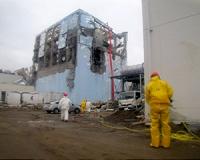 Battle to cool Japan plant as food jitters grow
Kitakami, Japan (AFP) March 23, 2011 Engineers racing to cool a stricken nuclear plant in Japan partially restored power to a control room on Tuesday, as radioactivity in more foodstuffs fuelled anxiety over product safety. An external electricity supply has now been linked up to all six reactors at the Fukushima No. 1 power station, more than a week after a 14-metre (46-foot) tsunami crippled the ageing facility. In anothe ... read more |
|
|
| The content herein, unless otherwise known to be public domain, are Copyright 1995-2010 - SpaceDaily. AFP and UPI Wire Stories are copyright Agence France-Presse and United Press International. ESA Portal Reports are copyright European Space Agency. All NASA sourced material is public domain. Additional copyrights may apply in whole or part to other bona fide parties. Advertising does not imply endorsement,agreement or approval of any opinions, statements or information provided by SpaceDaily on any Web page published or hosted by SpaceDaily. Privacy Statement |


 del.icio.us
 Digg
Digg Reddit
 YahooMyWeb
 Google
 Facebook


