
 |
 |
 |
 |
 |
 |
 |
 |
 |

 |
Gamma-ray Flare Star
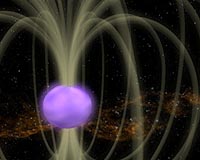
Science@NASA Huntsville AL (SPX) Feb 11, 2009 NASA's Swift and Fermi spacecraft are monitoring a neutron star 30,000 light years from Earth that is drawing attention to itself with a series of powerful gamma-ray flares. "At times, this remarkable object has erupted with more than a hundred flares in as little as 20 minutes," said Loredana Vetere, who is coordinating the Swift observations at Pennsylvania State University. "The most intense flares emitted more total energy than the sun does in 20 years." The star, known as SGR J1550-5418, lies in the southern constellation Norma. It began a series of modest eruptions on Oct. 3, 2008, settled down for a while, then roared back to life on Jan. 22, 2009, with an intense episode. Because of its rapid-fire outbursts and gamma-ray spectrum, astronomers classify the object as a "soft-gamma-ray repeater" - only the sixth known. In 2004, a giant flare from another soft-gamma-ray repeater was so intense it ionized Earth's upper aosphere from 50,000 light-years away. Using data from an X-ray telescope onboard Swift, Jules Halpern at Columbia University captured the first "light echoes" ever seen from a soft-gamma-ray repeater. Images acquired when the latest flaring episode began show what appear to be expanding halos around the source. Multiple rings form as X-rays interact with dust clouds at different distances. Scientists think the source of the flares is a spinning neutron star--the superdense, city-sized remains of a supernova. Although only about 12 miles across, a neutron star contains more mass than the sun. This particular neutron star is believed to be a "magnetar," a neutron star with an incredibly intense magnetic field. A popular theory of soft-gamma-ray repeaters holds that flares are caused by "starquakes" in the outer rigid crust of the magnetar. As a magnetar's colossal magnetic field shifts, it strains the crust with monstrous magnetic forces, often breaking it. When the crust snaps, it vibrates with seismic waves like in an earthquake and emits a flash of gamma-rays. No one is really certain of the details, however, and much work remains to be done to understand these powerfully hyperactive stars. NASA's Fermi Gamma-ray Space Telescope, launched in June 2008, is ideal for this work. "The ability of Fermi's gamma-ray burst monitor to resolve the fine structure within these events will help us better understand how magnetars unleash their energy," said Chryssa Kouveliotou, an astrophysicist at NASA's Marshall Space Flight Center in Huntsville, Ala. The object has triggered Fermi's gamma-ray burst monitor more than 95 times since Jan. 22nd. NASA's Wind satellite, the joint NASA-Japan Suzaku mission, and the European Space Agency's INTEGRAL satellite also have detected flares from SGR J1550-5418. The flashes continue! Stay tuned to Science@NASA for updates. Share This Article With Planet Earth
Related Links Science@NASA Stellar Chemistry, The Universe And All Within It
 Astronomers Use Gamma-Ray Burst To Probe Star Formation In The Early Universe
 Long Beach CA (SPX) Jan 13, 2009
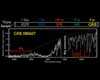
The brilliant afterglow of a powerful gamma-ray burst (GRB) has enabled astronomers to probe the star-forming environment of a distant galaxy, resulting in the first detection of molecular gas in a GRB host galaxy. By analyzing the spectrum of light emitted in the GRB afterglow, the researchers are gleaning insights into an active stellar nursery in a galaxy so far away it appears as it was 10 billion years ago. |
|
|

| The content herein, unless otherwise known to be public domain, are Copyright 1995-2007 - SpaceDaily.AFP and UPI Wire Stories are copyright Agence France-Presse and United Press International. ESA Portal Reports are copyright European Space Agency. All NASA sourced material is public domain. Additional copyrights may apply in whole or part to other bona fide parties. Advertising does not imply endorsement,agreement or approval of any opinions, statements or information provided by SpaceDaily on any Web page published or hosted by SpaceDaily. Privacy Statement |
 del.icio.us
 Digg
Digg Reddit
 YahooMyWeb
 Google
 Facebook