|
 |
 |
 |
 |
 |
 |
 |
 |

 |
 by Staff Writers Washington DC (SPX) Jul 31, 2019
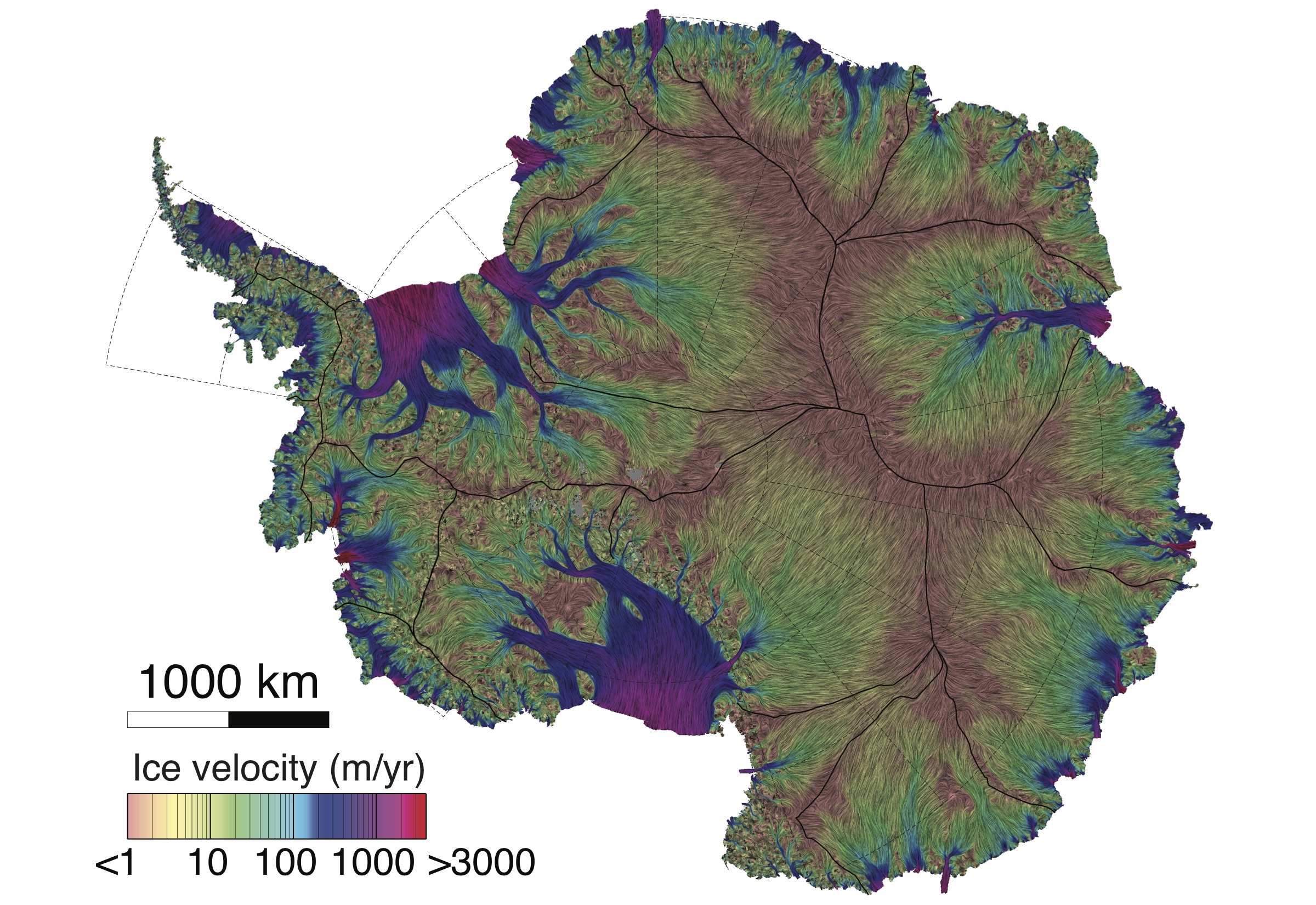
Constructed from a quarter century's worth of satellite data, a new map of Antarctic ice velocity by glaciologists from the University of California, Irvine and NASA's Jet Propulsion Laboratory is the most precise ever created. Published in a new paper in the AGU journal Geophysical Research Letters, the map is 10 times more accurate than previous renditions, covering more than 80 percent of the continent. "By utilizing the full potential of interferometric phase signals from satellite synthetic-aperture radars, we have achieved a quantum leap in the description of ice flow in Antarctica," said lead author Jeremie Mouginot, UCI associate researcher in Earth system science. "This more detailed representation will help improve our understanding of ice behavior under climate stress over a larger part of the continent, farther south, and will enable improved projections of sea level rise through numerical models." To chart the movement of ice sheets across the surface of the enormous land mass, the researchers combined input from six satellite missions: the Canadian Space Agency's Radarsat-1 and Radarsat-2; the European Space Agency's Earth remote sensing satellites 1 and 2 and Envisat ASAR; and the Japan Aerospace Exploration Agency's ALOS PALSAR-1. While the data were spread across 25 years, the pace of signal gathering accelerated in the last decade as more resources were deployed in the Earth's orbit. As ice sheet science coordinator in the World Meteorological Organization's Polar Space Task Group, co-author Bernd Scheuchl, UCI associate project scientist in Earth system science, was responsible for acquiring the relevant data from the various international space agencies. Previous mapping efforts relied heavily on "feature" and "speckle tracking" methods, which detect the subtle motion of parcels of ice on the ground over time; this approach has been proven effective in estimating ice flow speed. To measure significantly slower ice sheet movement in the vast interior regions, the UCI team augmented these techniques with synthetic-aperture radar phase interferometry, which detects the subtle motion of natural reflectors of radar signals in snow/ice independent of the size of the parcel of ice illuminated by the radar. "The interferometric phase of SAR data measures the ice deformation signal with a precision of up to two orders of magnitude better than speckle tracking," Mouginot said. "A drawback is that it requires a lot more data, namely multiple passes at different angles over the same point on the ground - a problem that was solved by a consortium of international space agencies pointing Earth-monitoring spacecrafts to this part of the world." The team was able to compose a map that resolves ice movement to a level of 20 centimeters (a little over half a foot) per year in speed and 5 degrees in annual flow direction for more than 70 percent of Antarctica. It's the first time that high-precision mapping of the interior areas has been accomplished. "This product will help climate scientists achieve a number of goals, such as a better determination of the boundaries between glaciers and a thorough evaluation of regional atmospheric climate models over the entire continent," said co-author Eric Rignot, chair and Donald Bren Professor of Earth System Science at UCI and a JPL senior research scientist. "It will also help in locating the most promising sites for ice core drilling to extract climate records and in examining the mass balance of Antarctica beyond its periphery." He said he's looking forward to the joint NASA and Indian Space Research Organization satellite, launching in late 2021, which will be the first interferometric-mode SAR mission designed to look solely toward the South Pole. The spacecraft will provide a coast-to-coast view of Antarctica every 12 days. "We'll be able to collect enough quality phase data over the Antarctic to generate updates to the map we just created in one or two months instead of one or two decades," Rignot said. "With this level of precision in the interior regions, we'll be able to reconstruct high-resolution spatial details in the bed topography beneath the ice through inversion techniques over far broader areas than in previous attempts - essential to improving ice sheet models and projections of sea level rise from Antarctica." The new Antarctic ice velocity map and related datasets are available for download at the NASA Distributed Active Archive Center at the National Snow and Ice Data Center. This project was supported by NASA's MEaSUREs program.
Research Report: "Continent-wide, interferometric SAR phase, mapping of Antarctic ice velocity"

West Antarctic ice collapse may be prevented by snowing ocean water onto it Potsdam, Germany (SPX) Jul 22, 2019 A team of researchers from the Potsdam Institute for Climate Impact Research (PIK) is now scrutinising a daring way of stabilising the ice sheet: Generating trillions of tons of additional snowfall by pumping ocean water onto the glaciers and distributing it with snow canons. This would mean unprecedented engineering efforts and a substantial environmental hazard in one of the world's last pristine regions - to prevent long-term sea level rise for some of the world's most densely populated areas along c ... read more
|
|||||||||||||
|
|
| The content herein, unless otherwise known to be public domain, are Copyright 1995-2024 - Space Media Network. All websites are published in Australia and are solely subject to Australian law and governed by Fair Use principals for news reporting and research purposes. AFP, UPI and IANS news wire stories are copyright Agence France-Presse, United Press International and Indo-Asia News Service. ESA news reports are copyright European Space Agency. All NASA sourced material is public domain. Additional copyrights may apply in whole or part to other bona fide parties. All articles labeled "by Staff Writers" include reports supplied to Space Media Network by industry news wires, PR agencies, corporate press officers and the like. Such articles are individually curated and edited by Space Media Network staff on the basis of the report's information value to our industry and professional readership. Advertising does not imply endorsement, agreement or approval of any opinions, statements or information provided by Space Media Network on any Web page published or hosted by Space Media Network. General Data Protection Regulation (GDPR) Statement Our advertisers use various cookies and the like to deliver the best ad banner available at one time. All network advertising suppliers have GDPR policies (Legitimate Interest) that conform with EU regulations for data collection. By using our websites you consent to cookie based advertising. If you do not agree with this then you must stop using the websites from May 25, 2018. Privacy Statement. Additional information can be found here at About Us. |


 del.icio.us
 Digg
Digg Reddit
 Google