
 |
 |
 |
 |
 |
 |
 |
 |
 |

 |

Vienna (AFP) July 20, 2010 As Haiti struggles to rebuild itself after a devastating earthquake, people with AIDS are still waiting for aid promised to them before the catastrophe, activists here said Tuesday. There are some 120,000 people with the human immunodeficiency virus or HIV in Haiti, which was hit by a huge earthquake on January 12, killing 250,000 people and leaving 1.5 million homeless. An international pledge of 500 million dollars (385 million euros) in reconstruction aid has been slow in materialising, with the World Bank saying last week that the fund was only 20 percent full. But people with HIV and AIDS are suffering even more as their previously promised aid also continues to trickle in only very slowly or not at all, according to organisations attending the World AIDS Conference this week in Vienna. "It's very difficult for grassroots organisations to operate since the quake. We simply don't have the means to do so," said Liony Acclus, head of PHAP+, a Haitian coalition of organisations for people with AIDS. Around 90 percent of all funding for AIDS in Haiti comes from abroad, Acclus said. "Since the quake, the programmes set up by international organisations to help people with AIDS to earn a living are no longer operating," complained Edner Boucicaut, head of Housing Works, a non-governmental organisation. It was still common practice that prospective employees had to prove they were HIV negative to get work, Boucicaut said. "We have to stop helping Haiti on paper and start taking action," said Liony Acclus. However, there are more optimistic voices. "We've lost 70 percent of our office space. But that isn't stopping us working," said Jean-William Pape, director of the Haitian NGO Gheskio. "The situation is not going to deteriorate, because health organisations are well organised." "What we hear about Haiti is always very negative, but before the earthquake, good things were happening there, in the health sector particularly," said Jonathan Quick, director of Management for Social Health (MSH). The prevalence rate of HIV in Haiti has declined from 6.2 percent in 1993 to 2.2 percent in the middle of this decade, Quick noted. Free care for people with AIDS, HIV tests and preliminary treatments are still available, Edner Boucicaut of Housing Works conceded. "But we still don't have second-line antiretrovirals (drugs used when a patient develops a resistance to the first treatment), and even before the quake, 43,000 people were not receiving treatment," he said. The organisations all share the view that the entire population be integrated into the process of reconstruction. In a joint statement, NGOs Gheskio, MSH, the Global Health Council and Partners in Health, called on the international community to direct its support to a "'whole of society' integrated approach to strengthening health systems as the best way to sustain HIV/AIDS prevention, care and treatment over the long term". Edner Boucicaut complained of a lack of coordination in the programmes of the NGOs and the government. "Integrate us into your programmes," he said. There is a general scepticism towards the public authorities in Haiti, with organisations saying people expect more of the UN's special envoy Bill Clinton than their own president Rene Preval.
Share This Article With Planet Earth
Related Links Epidemics on Earth - Bird Flu, HIV/AIDS, Ebola

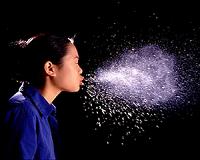 One In Four Not Covering Coughs Or Sneezes
Atlanta GA (SPX) Jul 19, 2010 Approximately 1 out of every 4 people observed in a public setting failed to cover their mouth when they coughed or sneezed according to research presented recently at the International Conference on Emerging Infectious Diseases. Even more concerning, less than 5 percent of people covered their mouth using methods recommended by public health officials. "We were surprised to find that this ... read more |
|
|
| The content herein, unless otherwise known to be public domain, are Copyright 1995-2010 - SpaceDaily. AFP and UPI Wire Stories are copyright Agence France-Presse and United Press International. ESA Portal Reports are copyright European Space Agency. All NASA sourced material is public domain. Additional copyrights may apply in whole or part to other bona fide parties. Advertising does not imply endorsement,agreement or approval of any opinions, statements or information provided by SpaceDaily on any Web page published or hosted by SpaceDaily. Privacy Statement |


 del.icio.us
 Digg
Digg Reddit
 YahooMyWeb
 Google
 Facebook


