
 |
 |
 |
 |
 |
 |
 |
 |
 |

 |
Happy Birthday, Columbus!
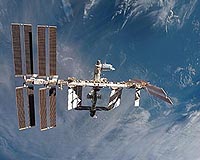
Bonn, Germany (SPX) Feb 12, 2009 On 7 February 2008, Space Shuttle Atlantis (flight STS-122) was launched from Kennedy Space Center in Florida to bring the Columbus space laboratory to the International Space Station, ISS. Columbus was permanently attached to the ISS and taken into operation on 11 February 2008, as the first European space laboratory for long-term research under space conditions. Columbus is Europe's main contribution to the ISS. It is expected to remain in service for at least ten years. Immediately after it had docked to the ISS, research on board Columbus began. From February to March 2008, for instance, the WAICO experiment (Waving and Coiling of Arabidopsis) was carried out. This gravitational biology experiment aims to establish the orientation of plants in the absence of gravity. WAICO was the first of a range of biological research experiments to be conducted in Biolab, one of the experiment racks in the Columbus laboratory. WAICO 2, the follow-up experiment, has been scheduled for summer 2009.
DLR experiments in the Columbus laboratory All three experiments are provided by the Institute of Aerospace Medicine (Institut fur Luft- und Raumfahrtmedizin) of the German Aerospace Center (Deutsches Zentrum fur Luft- und Raumfahrt; DLR). Another DLR experiment is SOLO. This human physiology experiment investigates if an increased dietary intake of salt intensifies the bone resorption that already occurs in weightless conditions even further. In total, some 40 German experiments have been started on board the ISS since 2001, and in some cases they have already been completed as well. This research has focused on the fields of biotechnology, aerospace medicine and plasma crystal research. At the moment, some 60 additional German experiments are awaiting implementation. In short, the astronauts have more than enough research work to do.
Columbus Control Center: On duty 24 hours a day Since last year, more than 75 scientists and engineers of the Industrial Operator Team (IOT) have been on duty for the European space laboratory, in order to ensure its round-the-clock operation. In total, they have already invested 240 000 working hours in the Columbus project. This has allowed the control centre to gain some important experience already. "The Columbus module has been operational for a year now, providing a platform for experiments in weightless conditions. However, constant monitoring from Earth is required to ensure a pleasant and safe working environment for the astronauts", says Dr Dieter Sabath, Head of Mission Operations at the Columbus Control Center. "The Flight Control Team has successfully prepared and carried all of the work required to operate Columbus during the first year. It has also provided support for the necessary maintenance work. It has become clear, however, that to ensure Columbus's long-term operation we need to spend almost exactly the same amount of time on preparatory work as on shift work at the terminals. For the moment, though, shift work still constitutes the greatest part of our activities."
Six astronauts on board ISS at all times from May 2009 This increased efficiency is essential for handling the intensified payload operation on board Columbus that will begin when Belgian ESA astronaut Frank de Winne boards the ISS for the European long-term mission OasISS in May. From that moment, the resident crew of the ISS will double in size from three to six astronauts. This means that astronauts will have more time to operate the experiments (an increase from about 30 to about 100 hours of astronaut labour hours per increment for ESA experiments). This in turn means that more work is required to prepare the additional experiments, and that more ground-based support is required during their operation, as it is possible that several experiments will be conducted at the same time. Frank de Winne's presence on board the ISS also brings about a substantial increase in the Columbus Control Center's workload, since it is the main point of contact for European astronauts. Share This Article With Planet Earth
Related Links Columbus Columbus blog Station at NASA Station and More at Roscosmos S.P. Korolev RSC Energia Watch NASA TV via Space.TV Space Station News at Space-Travel.Com
 Russian cargo ship blasts off for ISS
 Moscow (AFP) Feb 10, 2009
A Russian cargo ship carrying supplies for the International Space Station (ISS) blasted off Tuesday from the Baikonour cosmodrome, Russian state television pictures showed. |
|
|

| The content herein, unless otherwise known to be public domain, are Copyright 1995-2007 - SpaceDaily.AFP and UPI Wire Stories are copyright Agence France-Presse and United Press International. ESA Portal Reports are copyright European Space Agency. All NASA sourced material is public domain. Additional copyrights may apply in whole or part to other bona fide parties. Advertising does not imply endorsement,agreement or approval of any opinions, statements or information provided by SpaceDaily on any Web page published or hosted by SpaceDaily. Privacy Statement |
 del.icio.us
 Digg
Digg Reddit
 YahooMyWeb
 Google
 Facebook