
 |
 |
 |
 |
 |
 |
 |
 |
 |

 |
Heating Gold Makes It Harder Not Softer
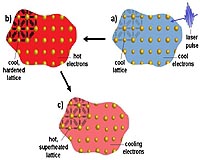
Toronto, Canada (SPX) Jan 23, 2009 Common sense tells us that when you heat something up it gets softer, but a team of researchers, led by University of Toronto chemistry and physics professor R.J. Dwayne Miller, has demonstrated the exact opposite. Their findings will be published online in the prestigious international journal Science. "It is counter-intuitive but the gold got harder instead of softer," says Miller. Can you imagine a blacksmith heating up gold to pound it thinner, only to find it got harder? But we heated the gold at terrific heating rates - greater than 1 billion million degrees per second - that approach the temperature of the interior of stars." The gold was heated at rates too fast for the electrons absorbing the light energy to collide with surrounding atoms and lose energy," he explains. "This means the electrons are on average further away from the atomic nucleus and there is less screening of the positive nuclear charge by these heated electrons. The bonds between atoms actually got stronger. "A gold crystal consists of gold ions and weakly bound electrons which screen the repulsive forces between the ions," explains lead author Ralph Ernstorfer, a former postdoctoral research fellow with Prof. Miller, who is now at the Max-Planck Institute for Quantum Optics in Garching and the TU Munich, Germany. As a result, there are attractive forces between ions. In contrast to many other materials, heating the electrons in gold with an ultrashort laser pulse makes the forces between the ions stronger, resulting in a harder lattice with an increased melting point. "The effect of bond hardening in gold has been theoretically predicted. Now we have actually observed it for the first time," says Ernstorfer. The researchers employed a technique called 'femtosecond electron diffraction' to make the observation. This technique can be described as a camera for making atomic-level movies. By sending femtosecond pulses of electrons through the thin gold crystal, the atomic motions of the ions were recorded in real time while heating the material with lasers. By measuring the speed of heating, amplitude of the atomic motions, and ultimate melting of the crystal, the laser-induced change of the lattice stability could be inferred. "We now have an atomic-level view of this rarified state of matter, referred to as warm dense matter, and can relate the observed liquid structure to the increased lattice stability," says Miller. Share This Article With Planet Earth
Related Links University of Toronto Space Technology News - Applications and Research
 Next Generation Cloaking Device Demonstrated
 Durham NC (SPX) Jan 19, 2009
A device that can bestow invisibility to an object by "cloaking" it from visual light is closer to reality. After being the first to demonstrate the feasibility of such a device by constructing a prototype in 2006, a team of Duke University engineers has produced a new type of cloaking device, which is significantly more sophisticated at cloaking in a broad range of frequencies. |
|
|

| The content herein, unless otherwise known to be public domain, are Copyright 1995-2007 - SpaceDaily.AFP and UPI Wire Stories are copyright Agence France-Presse and United Press International. ESA Portal Reports are copyright European Space Agency. All NASA sourced material is public domain. Additional copyrights may apply in whole or part to other bona fide parties. Advertising does not imply endorsement,agreement or approval of any opinions, statements or information provided by SpaceDaily on any Web page published or hosted by SpaceDaily. Privacy Statement |
 del.icio.us
 Digg
Digg Reddit
 YahooMyWeb
 Google
 Facebook