
 |
 |
 |
 |
 |
 |
 |
 |
 |

 |
Helium Rains Inside Jovian Planets
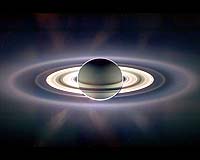
Livermore CA (SPX) Jan 28, 2009 Models of how Saturn and Jupiter formed may soon take on a different look. By determining the properties of hydrogen-helium mixtures at the millions of atmospheres of pressure present in the interior of Saturn and Jupiter, physicists at Lawrence Livermore National Laboratory and the University of Illinois at Urbana-Champaign have determined the temperature at a given pressure when helium becomes insoluble in dense metallic hydrogen. The results are directly relevant to models of the interior structure and evolution of Jovian planets. Hydrogen and helium are the two lightest and most common elements in the universe. Because of their ubiquitous nature, they are critical in cosmological nucleosynthesis and are essential elements of stars and giant planets. Hydrogen by itself in the observable universe provides clues to the origin and large-scale structures of galaxies. However, scientists have struggled to determine what conditions are needed for the two elements to mix. Using first-principle molecular dynamics simulations, Miguel Morales, a DOE Stewardship Science graduate fellow from David Ceperley's group at the University of Illinois worked with LLNL's Eric Schwegler, Sebastien Hamel, Kyle Caspersen and Carlo Pierleoni from the University of L'Aquila in Italy to determine the equation of state of the hydrogen-helium system at extremely high temperatures (4,000-10,000 degrees Kelvin), similar to what would be found in the interior of Saturn and Jupiter. The team used LLNL's extensive high-performance computing facilities to conduct simulations over a wide range of density, temperature and composition to locate the equation of state of the two elements. "Our simulation results are consistent with the idea that a large portion of the interior of Saturn has conditions such that hydrogen and helium phase separate," Morales said. "This can account for the apparent discrepancy between the current evolutionary models for Saturn and observational data." In addition to being made mostly of hydrogen and helium, a characteristic of Jovian planets is that they radiate more energy than they take in from the sun. Various models of their evolution and structure have been developed to describe a relation between the age, volume and mass of the planet and its luminosity. While this model works for Jupiter by modeling the energy radiation left over from its formation 4.55 billion years ago, it doesn't exactly work for Saturn. Instead, the model seriously underestimates the current luminosity of Saturn. So the researchers decided to try something different. They determined where helium and hydrogen mix as well as at what temperature they don't mix. It turned out the temperature where the two elements don't mix is high enough that helium is "partially mixable over a significant fraction of the interior of the Jovian planets with the corresponding region of Saturn being larger than in Jupiter," Schwegler said. "This, in fact, could change the current interior models of Saturn and Jupiter." Share This Article With Planet Earth
Related Links DOE/Lawrence Livermore National Laboratory Lands Beyond Beyond - extra solar planets - news and science Life Beyond Earth
 Transit Search Finds Super-Neptune
 Boston MA (SPX) Jan 22, 2009
Astronomers at the Harvard-Smithsonian Center for Astrophysics have discovered a planet somewhat larger and more massive than Neptune orbiting a star 120 light-years from Earth. While Neptune has a diameter 3.8 times that of Earth and a mass 17 times Earth's, the new world (named HAT-P-11b) is 4.7 times the size of Earth and has 25 Earth masses. |
|
|

| The content herein, unless otherwise known to be public domain, are Copyright 1995-2007 - SpaceDaily.AFP and UPI Wire Stories are copyright Agence France-Presse and United Press International. ESA Portal Reports are copyright European Space Agency. All NASA sourced material is public domain. Additional copyrights may apply in whole or part to other bona fide parties. Advertising does not imply endorsement,agreement or approval of any opinions, statements or information provided by SpaceDaily on any Web page published or hosted by SpaceDaily. Privacy Statement |
 del.icio.us
 Digg
Digg Reddit
 YahooMyWeb
 Google
 Facebook