
 |
 |
 |
 |
 |
 |
 |
 |
 |

 |

Toronto, Canada (SPX) Sep 24, 2010 Aviation history was made when the University of Toronto's human-powered aircraft with flapping wings became the first of its kind to fly continuously. The "Snowbird" performed its record-breaking flight on August 2 at the Great Lakes Gliding Club in Tottenham, Ont., witnessed by the vice-president (Canada) of the Federation Aeronautique Internationale (FAI), the world-governing body for air sports and aeronautical world records. The official record claim was filed this month, and the FAI is expected to confirm the ornithopter's world record at its meeting in October. For centuries engineers have attempted such a feat, ever since Leonardo da Vinci sketched the first human-powered ornithopter in 1485. But under the power and piloting of Todd Reichert, an Engineering PhD candidate at the University of Toronto Institute for Aerospace Studies (UTIAS), the wing-flapping device sustained both altitude and airspeed for 19.3 seconds, and covered a distance of 145 metres at an average speed of 25.6 kilometres per hour. "The Snowbird represents the completion of an age-old aeronautical dream," says lead developer and project manager Reichert. "Throughout history, countless men and women have dreamt of flying like a bird under their own power, and hundreds, if not thousands have attempted to achieve it. This represents one of the last of the aviation firsts." The Snowbird weighs just 94 lbs. and has a wing span of 32 metres (105 feet). Although its wingspan is comparable to that of a Boeing 737, the Snowbird weighs less than all of the pillows on board. Pilot Reichert lost 18 lbs. of body weight this past summer to facilitate flying the aircraft. With sustainability in mind, Aerospace Engineering graduate students of UTIAS learned to design and build lightweight and efficient structures. The research also promoted "the use of the human body and spirit," says Reichert. "The use of human power, when walking or cycling, is an efficient, reliable, healthy and sustainable form of transportation. Though the aircraft is not a practical method of transport, it is also meant to act as an inspiration to others to use the strength of their body and the creativity of their mind to follow their dreams." The Snowbird development team is comprised of two University of Toronto Engineering graduate students: Reichert, and Cameron Robertson (MASc 2009) as the chief structural engineer; UTIAS Professor Emeritus James D. DeLaurier as faculty advisor; and community volunteers Robert and Carson Dueck. More than 20 students from the University of Toronto and up to 10 exchange students from Poitiers University, France, and Delft Technical University, Netherlands, also participated in the project. "This achievement is the direct result of Todd Reichert's dedication, perseverance, and ability and adds to the already considerable legacy of Jim DeLaurier, UTIAS's great ornithopter pioneer," said Professor David Zingg, Director of UTIAS. "It also reflects well on the rigorous education Todd received at the University of Toronto. We're very proud of Todd and the entire team for this outstanding achievement in aviation history."
Share This Article With Planet Earth
Related Links University of Toronto Aerospace News at SpaceMart.com

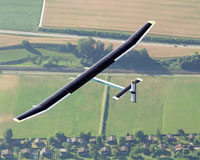 Swiss solar plane completes flight across Switzerland
Geneva (AFP) Sept 22, 2010 Switzerland's sun-powered plane Solar Impulse flew across the country Wednesday, in a new achievement following its historic 24-hour flight. Air traffic was temporarily halted at Zurich international airport as Solar Impulse touched down at the end of its journey at an altitude of 150 to 300 metres (500 to 1,000 feet), and a speed of about 50 kilometres (30 miles) per hour, a spokeswoman sa ... read more |
|
|
| The content herein, unless otherwise known to be public domain, are Copyright 1995-2010 - SpaceDaily. AFP and UPI Wire Stories are copyright Agence France-Presse and United Press International. ESA Portal Reports are copyright European Space Agency. All NASA sourced material is public domain. Additional copyrights may apply in whole or part to other bona fide parties. Advertising does not imply endorsement,agreement or approval of any opinions, statements or information provided by SpaceDaily on any Web page published or hosted by SpaceDaily. Privacy Statement |


 del.icio.us
 Digg
Digg Reddit
 YahooMyWeb
 Google
 Facebook


