
 |
 |
 |
 |
 |
 |
 |
 |
 |

 |
ISS, Discovery crews meet, get down to business
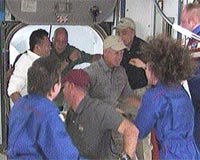
Washington (AFP) March 17, 2009 Soaring through space, Discovery's astronauts greeted colleagues from the International Space Station after the shuttle docked to deliver the ISS' first Japanese crewmember and key parts to finish the station's construction. The two vessels linked up at 2119 GMT Tuesday as they flew high over southern Australia, around six minutes behind the estimated docking time. Then the shuttle and ISS crews opened hatches and greeted each another at 6:09 pm, to begin more than a week of work together, NASA said. "One of the first major tasks of the crews was to swap station crew member Sandra Magnus for Japanese astronaut Koichi Wakata. The official swap occurred when a specially fitted seat liner was installed in the Soyuz crew vehicle," NASA said in a statement. "That swap at 9:00 pm signified the official designation change making Wakata an Expedition 18 flight engineer and Magnus a shuttle mission specialist." Wednesday, a vital piece of business will be transferring a key truss segment out of Discovery's payload bay with the shuttle robot arm to "hand it off to the station's mechanical arm for an overnight stay before Thursday's permanent installation on the station," NASA added. During their 13-day mission, the Discovery crew, including Wakata, the first long-stay Japanese crewmember on the ISS, will install two pairs of solar panels to the space station, one of the last major tasks of the more than decade-long effort to construct the orbiting outpost. Installing the solar panels was to have taken a two-astronaut team four space walks of more than six hours each to complete, according to NASA's original plans. But after lift-off was delayed last week because of a hydrogen leak, the solar panels are now due to be installed during three space walks, the first one set for Thursday, NASA said. The pairs of solar panels contain 32,800 solar cells and measure 35 meters (115 feet) long. Once the full array of solar panels is in place on the space station, they will provide enough electricity to fully power scientific experiments and support an expanded crew of six, due to arrive at the ISS in May. A crew of three -- two Americans and one Russian -- welcomed Discovery when it docked with the ISS. Wakata is replacing US astronaut Magnus who has spent four months on the ISS. The Japanese crewmember is scheduled to return to Earth in June. Shuttle commander Lee Archambault began maneuvering Discovery into position around an hour before docking, slowly pivoting the massive vessel onto its back to allow the crewmembers on board the ISS to snap photographs of the shuttle's underbelly as it and the space station flew high above South America. "Orbiter looked clean, very nice," ISS commander Mike Fincke told mission control. The photographs were sent back to mission control to be analyzed along with data gathered by the seven-member Discovery crew on Monday in a five-hour series of safety checks of the wings and nose, for which the crew unfurled a long robotic arm mounted with a camera. Checks for damage sustained on lift-off have become standard operating procedure since February 2003, when the Columbia shuttle disintegrated as it re-entered Earth's atmosphere, killing all seven crewmembers. The accident was blamed on a piece of debris that broke off the external tank at launch and struck one of Columbia's wings, gouging a hole into it. When Columbia was just minutes away from touchdown, super-heated air penetrated the aircraft's insulation and burned through the structure of the wing, eventually causing the shuttle to break up. The shuttle program resumed with the first lift-off of Discovery in July 2005. The shuttle that took off on Sunday from Cape Canaveral in Florida was the 36th Discovery mission and the 125th shuttle mission. Launch director Mike Leinbach called the liftoff the "most visually beautiful" he has ever seen. It has been a near picture-perfect mission so far, barring the delayed lift-off, some pesky space rubble that had US and Russian experts braced to move the 100-billion-dollar ISS in an "avoidance maneuver," and a piece of zero-gravity exercise equipment that went on the fritz. The alert over the space junk, believed to be from a Soviet satellite that broke up shortly after it lifted off in 1981, was called off Monday when data showed that the debris posed no danger to the space station. And the astronauts set about cobbling together some low-tech "rubber bungee-type equipment" to allow them to use the broken ergometer and get exercise to help battle the deleterious effects of microgravity on the body. Discovery will return to Earth on March 27, one day after a Russian Soyuz mission takes off for the ISS carrying a crew of three, including US billionaire businessman Charles Simonyi, on his second trip as a space tourist costing him a cool 35 million dollars. Share This Article With Planet Earth
Related Links Station at NASA Station and More at Roscosmos S.P. Korolev RSC Energia Watch NASA TV via Space.TV Space Station News at Space-Travel.Com
 Expedition 18 Ready To Take A Walk
 Houston TX (SPX) Mar 10, 2009
Aboard the orbiting International Space Station Monday, the Expedition 18 crew had a bit of down time. After Sunday's suited fit check of their Orlan spacesuits, Commander Mike Fincke and Flight Engineer Yury Lonchakov relaxed Monday in advance of their spacewalk slated to begin at 12:20 p.m. EDT Tuesday. Lonchakov, the lead spacewalker or EV 1, will wear the Orlan suit with the blue stripes. |
|
|

| The content herein, unless otherwise known to be public domain, are Copyright 1995-2007 - SpaceDaily.AFP and UPI Wire Stories are copyright Agence France-Presse and United Press International. ESA Portal Reports are copyright European Space Agency. All NASA sourced material is public domain. Additional copyrights may apply in whole or part to other bona fide parties. Advertising does not imply endorsement,agreement or approval of any opinions, statements or information provided by SpaceDaily on any Web page published or hosted by SpaceDaily. Privacy Statement |
 del.icio.us
 Digg
Digg Reddit
 YahooMyWeb
 Google
 Facebook