
 |
 |
 |
 |
 |
 |
 |
 |
 |

 |
Russia Says Verbal Deal To Keep Station OPen Until 2020
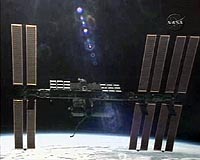
Moscow (RIA) Feb 06, 2009 Russia and its International Space Station partners have an oral agreement to continue using the orbiter until 2020, the president of leading Russian spacecraft maker RSC Energia said on Thursday. "The ISS partners have not yet signed any documents, but verbally we have already settled the initiative [to extend the station's use]," Vitaly Lopota said at a news conference in Moscow. Russia's partners in the International Space Station program are the United States, Canada, Japan, and the European Space Agency. Noting that in May the station's crew will be expanded from three to six astronauts, Lopota said Russia would not change the number of scheduled space flights because of the financial crisis. A record 39 space launches are planned for 2009, as opposed to last year's 27. "All of the launches that we planned for this year have been set," he said. "Everything that needs to be completed this year will be completed." The orbital assembly of the ISS began with the launch of the U.S.-funded and Russian-built Zarya module from Kazakhstan on November 20, 1998. Zarya, which means 'dawn,' was the ISS's first component. The United States earlier said the ISS should be scrapped in 2015.
Source: RIA Novosti Share This Article With Planet Earth
Related Links ISS Station at NASA Station and More at Roscosmos S.P. Korolev RSC Energia Watch NASA TV via Space.TV Space Station News at Space-Travel.Com
 A European OasISS In Space
 Paris, France (ESA) Feb 06, 2009
In May 2009, Frank De Winne, of Belgian nationality and a member of the European Astronaut Corps, will fly to the International Space Station at the start of his six-month mission. This mission sees him become the first European commander of the Station by October 2009. ESA has now given his mission the name OasISS. |
|
|

| The content herein, unless otherwise known to be public domain, are Copyright 1995-2007 - SpaceDaily.AFP and UPI Wire Stories are copyright Agence France-Presse and United Press International. ESA Portal Reports are copyright European Space Agency. All NASA sourced material is public domain. Additional copyrights may apply in whole or part to other bona fide parties. Advertising does not imply endorsement,agreement or approval of any opinions, statements or information provided by SpaceDaily on any Web page published or hosted by SpaceDaily. Privacy Statement |
 del.icio.us
 Digg
Digg Reddit
 YahooMyWeb
 Google
 Facebook