
 |
 |
 |
 |
 |
 |
 |
 |
 |

 |
'IceCube' telescope under construction
Newark, Del. (UPI) Dec 16, 2008 An international team of scientists is working under Antarctica's snow-covered surface to build the world's largest neutrino telescope. The telescope -- called "IceCube" -- will occupy a cubic kilometer of Antarctica when it is completed in 2011, said University of Delaware Professor Thomas Gaisser, one of the project's lead scientists. "IceCube will provide new information about some of the most violent and far-away astrophysical events in the cosmos," said Gaisser, who is managing the deployment of the telescope's surface array of detectors, known as "Ice Top." The telescope consists of kilometer-long -- 0.62-mile -- strings of 60 optical detectors frozen more than a mile deep in the Antarctic ice, the scientist said. Atop each string of deep detectors is a pair of 600-gallon IceTop tanks, each containing two optical detectors. The surface IceTop detectors measure cascades of neutrino particles generated by high-energy cosmic rays, while the detectors deep in the ice monitor neutrinos passing up through the planet from below. The system is designed so scientists can reconstruct the path of the particles and trace where they came from, perhaps an exploding star or a black hole. The University of Delaware is among 33 institutions contributing to the National Science Foundation project, which is coordinated by the University of Wisconsin. Share This Article With Planet Earth
Related Links Space Telescope News and Technology at Skynightly.com
 The Incredible Journey Of The James Webb Space Telescope
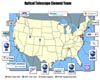 Greenbelt MD (SPX) Dec 11, 2008
The James Webb Space Telescope, targeted for launch in 2013, is already taking an incredible journey right here on Earth. It's zigzagging up, down, and across the US to be "spit and polished" to perfection for its lofty space mission. |
|
|

| The content herein, unless otherwise known to be public domain, are Copyright 1995-2007 - SpaceDaily.AFP and UPI Wire Stories are copyright Agence France-Presse and United Press International. ESA Portal Reports are copyright European Space Agency. All NASA sourced material is public domain. Additional copyrights may apply in whole or part to other bona fide parties. Advertising does not imply endorsement,agreement or approval of any opinions, statements or information provided by SpaceDaily on any Web page published or hosted by SpaceDaily. Privacy Statement |

 del.icio.us
 Digg
Digg Reddit
 YahooMyWeb
 Google
 Facebook