
 |
 |
 |
 |
 |
 |
 |
 |
 |

 |
In Bound At Mars Speed And Some More
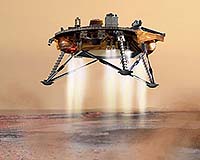
Pasadena, CA (JPL) May 25, 2008 NASA's Phoenix spacecraft successfully landed on Mars' frigid north pole region late Sunday in a risk-fraught mission to search for signs of habitability, the US space agency said. "Phoenix has landed," a NASA official said as the safe touchdown was confirmed. Images from the landing zone will hopefully be available in about two hours. This is the first successful rocket landing on Mars since 1976. The Mars Phoenix Lander successfully deployed a parachute and then thrusters to brake in a tense seven minutes from 20,400 kilometers per hour (12,700 miles per hour) to manage a soft landing on its three legs. Mission officials at the Jet Propulsion Laboratory (JPL) in Pasadena, California, were seen on television cheering and giving each other hugs and high-fives after signals sent back from the craft confirmed the arrival of the first spacecraft ever to land on the Martian arctic. The 420-million-dollar spacecraft is designed to help scientists assess whether the Martian arctic has ever had conditions favorable to microbial life. Given that Mars' polar region is subject to Earth-like seasonal changes, the scientists are looking to see whether there is a point where the region warms and changes into a water-rich soil with organic, life-supporting minerals. "Our whole mission is about digging," said Peter Smith, Phoenix principal investigator at the University of Arizona. "We find that the arctic region is really sensitive to climate change on a planet ... it also preserves the history of life," Smith said. "We think that organics must have existed at least at one time" from meteorite and other impacts, he said. The presence of liquid water and organics would signify a "habitable zone," he said. Phoenix managed an almost perfect landing in a relatively rock-free, flat target area in the flat circumpolar region known as Vastitas Borealis -- akin to northern Canada in Earth's latitude, according to Barry Goldstein, Phoenix project manager at JPL. The team had been worried about the high risk of the project, with a roughly 50 percent failure rate on all Mars missions since the Russians launched the first one in 1960. "Frankly, this was by far the hardest part," Goldstein said on NASA TV. "In my dreams it couldn't have gone as perfectly as it did tonight." NASA will only know that the landing and deployment of Phoenix's equipment went well after pictures from the probe reach the Earth via NASA's Odyssey Mars orbiter, two hours after the landing. The first pictures will be of the craft itself, to show NASA if all the equipment deployed in working order, and then, possibly shots of the surface. Phoenix is equipped with a camera and a 2.35-meter (7.7-foot) robotic arm that can dig as deep as one meter to find ice, and can heat up samples to detect carbon and hydrogen molecules, essential elements of life. It also has meteorological equipment to study the Mars atmosphere. Community Email This Article Comment On This Article Share This Article With Planet Earth
Related Links Phoenix at NASA Phoenix at APL Mars News and Information at MarsDaily.com Lunar Dreams and more
 In Bound At Mars Speed And Some More
 Pasadena, CA (JPL) May 25, 2008
NASA's Phoenix Mars Lander sped on Sunday morning toward its arrival at Mars, as the tug of the Red Planet's gravity accelerated the craft during the final day of its trip from Earth to Mars. |
|
|

| The content herein, unless otherwise known to be public domain, are Copyright 1995-2007 - SpaceDaily.AFP and UPI Wire Stories are copyright Agence France-Presse and United Press International. ESA Portal Reports are copyright European Space Agency. All NASA sourced material is public domain. Additional copyrights may apply in whole or part to other bona fide parties. Advertising does not imply endorsement,agreement or approval of any opinions, statements or information provided by SpaceDaily on any Web page published or hosted by SpaceDaily. Privacy Statement |
 del.icio.us
 Digg
Digg Reddit
 YahooMyWeb
 Google
 Facebook