|
India Mulls New Satellite For Cheaper Mobile Phone Link
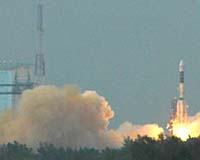
New Delhi, India (XNA) Oct 04, 2007 India is planning to launch a satellite capable of providing direct communication links to mobile handsets in three years, the Press Trust of India (PTI) reported Tuesday. The move aims at making satellite phone usage cheaper and accessible to the remotest parts of the country, the Indian Space Research Organization (ISRO) declared Monday. "We plan to provide satellite connectivity using a special bandwidth," ISRO chairman G Madhavan Nair told space agency chiefs attending the International Aeronautical Congress (IAC) in the southern Indian city of Hyderabad. The ISRO, he said, was designing an experimental satellite -- GSAT-6 -- for the purpose. "It will make access cheaper with connectivity even in remote areas." The GSAT-6 will be launched by the indigenous GSLV (Geosynchronous Satellite Launch Vehicle) and deployed in the geo-stationary orbit at 36,000 km from earth by 2010. "A subscriber will be able to connect his or her GSM phone when signals from the mobile service provider fail or do not reach by automatically switching over to the satellite link," PTI quoted ISRO scientific secretary Bhaskara Narayana as saying.
Source: Xinhua News Agency Community Email This Article Comment On This Article Related Links The latest information about the Commercial Satellite Industry
 Lockheed Martin-Built BSAT-3a Satellite Begins Service For B-SAT Customers
 Newtown PA (SPX) Oct 02, 2007
The BSAT-3a broadcasting satellite, designed and built by Lockheed Martin [NYSE: LMT], is now operational for the Broadcasting Satellite System Corporation (B-SAT) following successful on-orbit deployment and checkout of all spacecraft systems. The BSAT-3a communications payload contains 12 130-W Ku-band channels (eight operating at one time). With a design life of more than 13 years, BSAT-3a is based on the A2100A platform manufactured by Lockheed Martin Commercial Space Systems (LMCSS),Newtown, Pa. BSAT-3a marks the 12th Lockheed Martin satellite contract awarded in the 1- to 4-kW class satellite range. |
|
|
| The content herein, unless otherwise known to be public domain, are Copyright Space.TV Corporation. AFP and UPI Wire Stories are copyright Agence France-Presse and United Press International. ESA Portal Reports are copyright European Space Agency. All NASA sourced material is public domain. Additional copyrights may apply in whole or part to other bona fide parties. Advertising does not imply endorsement, agreement or approval of any opinions, statements or information provided by Space.TV Corp on any Web page published or hosted by Space.TV Corp. Privacy Statement |