
 |
 |
 |
 |
 |
 |
 |
 |
 |

 |

Heidelberg, Germany (SPX) Jan 27, 2011 The sight of a researcher sitting at a microscope for hours, painstakingly searching for the right cells, may soon be a thing of the past, thanks to new software created by scientists at the European Molecular Biology Laboratory (EMBL) in Heidelberg, Germany. Presented in Nature Methods, the novel computer programme can rapidly learn what the scientist is looking for and then takes over this laborious and time-consuming task, automatically performing complex microscopy experiments when it detects cells with interesting features. Called Micropilot, the software brings machine learning to microscopy. It analyses low-resolution images taken by a microscope and, once it has identified a cell or structure the scientists are interested in, it automatically instructs the microscope to start the experiment. This can be as simple as recording high-resolution time-lapse videos or as complex as using lasers to interfere with fluorescently tagged proteins and recording the results. The software is a boon to systems biology studies, as it generates more data, faster. In a mere four nights of unattended microscope operation, Micropilot detected 232 cells in two particular stages of cell division and performed a complex imaging experiment on them, whereas an experienced microscopist would have to work full-time for at least a month just to find those cells among the many thousands in the sample. With such high throughput, Micropilot can easily and quickly generate enough data to obtain statistically reliable results, allowing scientists to probe the role of hundreds of different proteins in a particular biological process. Jan Ellenberg and Rainer Pepperkok, whose teams at EMBL designed Micropilot, have used the software to deploy several different microscopy experiments, investigating various aspects of cell division. They determined when structures known as endoplasmic reticulum exit sites form, and uncovered the roles of two proteins, CBX1 and CENP-E, in condensing genetic material into tightly-wound chromosomes and in forming the spindle which helps align those chromosomes. This software will be a key tool for the European systems biology projects Mitosys and SystemsMicroscopy, for which Ellenberg and Pepperkok are developing technology. The Micropilot software is available as open source code. Conrad, C., Wunsche, A., Tan, T.H., Bulkescher, J., Sieckmann, F., Verissimo, F., Edelstein, A., Walter, T., Liebel, U., Pepperkok, R. and Ellenberg, J. Micropilot: automation of fluorescence microscopy- based imaging for systems biology. Nature Methods, Advance Online Publication 23 January 2011. DOI: 10.1038/NMETH.1558.
Share This Article With Planet Earth
Related Links European Molecular Biology Laboratory (EMBL) All about the robots on Earth and beyond!

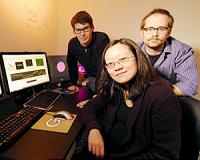 LCD Projector Used To Control Brain And Muscles Of Tiny Organisms Such As Worms
Atlanta GA (SPX) Jan 17, 2011 Researchers are using inexpensive components from ordinary liquid crystal display (LCD) projectors to control the brain and muscles of tiny organisms, including freely moving worms. Red, green and blue lights from a projector activate light-sensitive microbial proteins that are genetically engineered into the worms, allowing the researchers to switch neurons on and off like light bulbs and turn ... read more |
|
|
| The content herein, unless otherwise known to be public domain, are Copyright 1995-2010 - SpaceDaily. AFP and UPI Wire Stories are copyright Agence France-Presse and United Press International. ESA Portal Reports are copyright European Space Agency. All NASA sourced material is public domain. Additional copyrights may apply in whole or part to other bona fide parties. Advertising does not imply endorsement,agreement or approval of any opinions, statements or information provided by SpaceDaily on any Web page published or hosted by SpaceDaily. Privacy Statement |


 del.icio.us
 Digg
Digg Reddit
 YahooMyWeb
 Google
 Facebook


