|
 |
 |
 |
 |
 |
 |
 |
 |

 |
Iran Determined To Protect Its Interests In Caspian Region
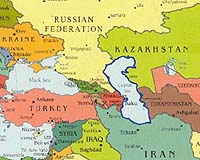
Tehran, Iran (RIA Novosti) Oct 18, 2007 Tehran will not sign any agreements on the status of the Caspian Sea until its national interests in the region are fully safeguarded, Iran's deputy foreign minister said Wednesday. "We will make a determined effort to protect Iran's interests in the Caspian region," Mehdi Safari said on national TV after the conclusion of the second Caspian summit in the Iranian capital. "Until Iran's national interests in the region are fully respected, we will not make any commitments or sign any agreements," he said. The status of the inland sea has been a source of long-running disagreements between the five littoral states - Azerbaijan, Iran, Kazakhstan, Russia, and Turkmenistan - since the collapse of the Soviet Union in 1991. The main stumbling block to delimiting the sea has been the position of Iran, which claims 20 percent of the water area. The initial principle determining which part of the Caspian is to be passed to the national jurisdiction of each of the littoral state relied on shoreline length. The Iranian portion makes up only 14 percent of the Caspian perimeter. At the Tuesday summit in Tehran, Caspian leaders showed no signs of progress toward resolving the dispute, but adopted a joint political declaration promoting efforts to build and enhance mutual confidence, regional security, and stability, and to refrain from the use of force in solving mutual problems. The document also said a future convention on the legal status of the sea, which is believed to contain the world's third-largest reserves of oil and natural gas, should respect the sovereign rights of Caspian states, and include environmental regulations, navigation norms and economic rules. The Iranian official praised the declaration as an important document on goodwill cooperation and neighborly relations between the littoral states, but said Tehran would never allow anybody to infringe on its rights in the region. "We are convinced that only a consensus among the five Caspian states has legitimate authority," Safari said. "Bilateral or trilateral agreements cannot serve as criteria for determining the legal status of the Caspian Sea." Russia, Kazakhstan and Azerbaijan have agreed so far to divide the Caspian seabed according to national sectors along the so-called modified median line, leaving the sea itself for common use. This has enabled the three states to agree upon the delimitation of the Caspian floor on adjacent sectors and conclude bilateral agreements to exercise sovereign rights on the use of mineral resources.
Source: RIA Novosti Community Email This Article Comment On This Article Related Links Powering The World in the 21st Century at Energy-Daily.com
 Ownership Problems Delay Second Leg Of Yamal-Europe Gas Pipeline
 Minsk, Russia (RIA Novosti) Oct 18, 2007
The construction of a second leg of a pipeline delivering natural gas via Belarus to Europe has been delayed due to ownership disputes, Russia's ambassador to Belarus said on Wednesday. Belarusian President Alexander Lukashenko proposed on October 12 that Russia start to build a second leg of the Yamal-Europe gas pipeline, and offered free transit for five years. Alexander Surikov said the delay was unrelated to Russian state gas giant Gazprom's problems in Belarus: "We burnt our fingers with the first leg due to ownership problems in Poland, and the construction of the second leg is being delayed until this issue is resolved." |
|
|
| The content herein, unless otherwise known to be public domain, are Copyright Space.TV Corporation. AFP and UPI Wire Stories are copyright Agence France-Presse and United Press International. ESA Portal Reports are copyright European Space Agency. All NASA sourced material is public domain. Additional copyrights may apply in whole or part to other bona fide parties. Advertising does not imply endorsement, agreement or approval of any opinions, statements or information provided by Space.TV Corp on any Web page published or hosted by Space.TV Corp. Privacy Statement |