
 |
 |
 |
 |
 |
 |
 |
 |
 |

 |

Washington DC (SPX) Dec 17, 2010 One of the rarest metals on Earth may be an excellent option for enabling future flash memory chips to continue to increase in speed and density, according to a group of researchers in Taiwan. "Incorporating nanocrystals of iridium into the critical floating gate portion of flash memory designs shows both excellent memory properties as well as stability in the high temperatures used in processing such semiconductor devices," says the research team leader, Wen-Shou Tseng of Taiwan's Center for Measurement Standards, Industrial Technology Research Institute. The research results appears in the journal Applied Physics Letters, which is published by the American Institute of Physics. His colleagues included students and professor at the nearby National Chiao Tung University and Chung Hua University. This team chose iridium - a hard, dense and corrosion-resistant metal in the platinum family that is one of the rarest metals found in the earth's crust - because unlike most alternatives, it has two desired properties: Iridium holds its electrons strongly (it has a high "work function", which is well-known to correlate with excellent memory properties), and its melting point of nearly 2,500 degrees Celcius is well beyond the 900 C annealing temperature that many chips must survive during manufacturing. Fortunately only a billionth of a billionth of a gram of iridium would be needed for each gate. Researchers worldwide are investigating new ways to improve the popular flash memory, which is the nonvolatile memory chip design used in virtually all digital cameras and mobile electronics and, increasingly, in solid-state drives for laptop computers. The easiest way for future flash memories to hold more data and read/write faster, is to shrink the dimensions of the existing chip design, including the floating gate. But today's gate design has already progressed to the point where it cannot get much smaller before it can no longer retain the electrical charges that actually store the data. Nanocrystals have been proposed as a rather simple change that can improve memory chip performance without changing the tried-and-true floating-gate design. In recent years, many different metals have been investigated for their nanocrystal potential. Nickel and tungsten, for example, are attractive for, respectively, a high work function and thermal stability. But they and other elements lack both needed properties. It is rare, indeed, that iridium has both needed qualities, Tseng says.
Share This Article With Planet Earth
Related Links American Institute of Physics Computer Chip Architecture, Technology and Manufacture Nano Technology News From SpaceMart.com

 Making Wafers Faster By Making Features Smaller
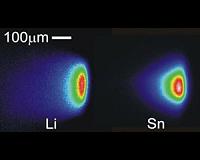
Washington DC (SPX) Dec 17, 2010 The manufacturing of semiconductor wafers used in all types of electronics involves etching small features onto a wafer with lasers, a process that is ultimately limited by the wavelength of the light itself. The semiconductor industry is rapidly approaching this fundamental limit for increasing the speed of the microchip. The development of a new intense 13.5-nm (extreme ultraviolet or EU ... read more |
|
|
| The content herein, unless otherwise known to be public domain, are Copyright 1995-2010 - SpaceDaily. AFP and UPI Wire Stories are copyright Agence France-Presse and United Press International. ESA Portal Reports are copyright European Space Agency. All NASA sourced material is public domain. Additional copyrights may apply in whole or part to other bona fide parties. Advertising does not imply endorsement,agreement or approval of any opinions, statements or information provided by SpaceDaily on any Web page published or hosted by SpaceDaily. Privacy Statement |


 del.icio.us
 Digg
Digg Reddit
 YahooMyWeb
 Google
 Facebook


