
 |
 |
 |
 |
 |
 |
 |
 |
 |

 |
Israel tests Arrow interceptor missile
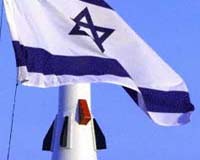
Jerusalem (AFP) April 7, 2009 Israel on Tuesday tested its Arrow ballistic missile interception system, a costly project launched two decades ago aimed at countering strikes mainly from archfoe Iran. The Arrow (Hetz in Hebrew) intercepted and destroyed a ballistic missile similar to Iran's Shahab-3 which can reach Israel. The missile was fired by an Israeli fighter plane over the Mediterranean, a defence official said. "This morning, the Arrow system performed a successful test," the defence ministry said in a statement. "The success of the project marks a key step in its development plan and the improvement of the operational systems to offer a response to the growing threat of ballistic missiles in the region." Defence Minister Ehud Barak, who watched the test from a helicopter, said that combined with other rocket and missile interception systems under development, the Arrow project "will offer optimal protection from near and immediate strategic threats," in the ministry statement. Prime Minister Benjamin Netanyahu hailed the test launch, saying: "We seek peace but we will know how to protect ourselves." It was the latest successful test of the Arrow, a project launched in 1988 during the now-defunct Star Wars programme under late US president Ronald Reagan. The Arrow programme was stepped up after Israel was hit by 39 Iraqi Scud missiles during the 1991 Gulf War. Development of the Arrow is now half-funded by Israel's main ally, the United States. Israel says it has carried out more than a dozen successful tests of the Arrow under various conditions. Israel considers Iran to be its arch-foe following repeated calls by President Mahmoud Ahmadinejad for the Jewish state to be wiped off the map. Widely considered to be the Middle East's sole nuclear armed state, Israel and Washington suspect Iran of trying to develop atomic weapons under the guise of its civilian nuclear programme, a charge Tehran has repeatedly denied. In March, Iran said it had successfully tested an air-to-sea missile with a 110-kilometre (70-mile) range. The announcement came days after a top military commander said Tehran has missiles that can reach nuclear facilities in Israel. Mohammed Ali Jafari, the head of Iran's Revolutionary Guards Corps, said Tehran has missiles with a range of more than 2,000 kilometres, bringing all of Israel within range. But defence analysts question the accuracy of Iran's longer-range missiles. Jafari's comment came amid sustained speculation that Israel, which has a nuclear facility at Dimona in the Negev desert at which it is widely believed to have developed a nuclear arsenal, could target Iranian nuclear plants. Share This Article With Planet Earth
Related Links Learn about missile defense at SpaceWar.com Learn about nuclear weapons doctrine and defense at SpaceWar.com All about missiles at SpaceWar.com Learn about the Superpowers of the 21st Century at SpaceWar.com
 Czechs don't expect US to scrap missile shield plans
 Brussels (AFP) April 2, 2009
Czech Deputy Premier Alexandr Vondra said Thursday he is not expecting the US to scrap its missile shield plans in Europe, despite President Barack Obama's decision to review the scheme which Moscow opposes. |
|
|

| The content herein, unless otherwise known to be public domain, are Copyright 1995-2007 - SpaceDaily.AFP and UPI Wire Stories are copyright Agence France-Presse and United Press International. ESA Portal Reports are copyright European Space Agency. All NASA sourced material is public domain. Additional copyrights may apply in whole or part to other bona fide parties. Advertising does not imply endorsement,agreement or approval of any opinions, statements or information provided by SpaceDaily on any Web page published or hosted by SpaceDaily. Privacy Statement |
 del.icio.us
 Digg
Digg Reddit
 YahooMyWeb
 Google
 Facebook