
 |
 |
 |
 |
 |
 |
 |
 |
 |

 |
James Webb Space Telescope's Actual Spine Now Being Built
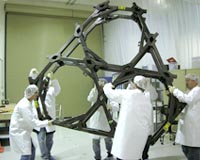
Magna UT (SPX) Feb 10, 2009 Scientists and engineers who have been working on the James Webb Space Telescope mission for years are getting very excited, because some of the actual pieces that will fly aboard the Webb telescope are now being built. One of the pieces, called the Backplane, is like a "spine" to the telescope. The Backplane is now being assembled by Alliant Techsystems at its Magna, Utah facility. The Webb telescope stands as big as a two-story house, and the Backplane is a core part of the design as it will support the telescope?s 21-foot diameter (6.5 meter) primary mirror. Not only will the Backplane be carrying a large mirror, but it will be supporting a lot of weight. It will be carrying 7,500 lbs (2400 kg) of telescope optics and instruments during space launch to the telescope?s operational position 990,000 miles (1,584,000 km) from Earth. "The Webb telescope's ultimate ability to discover the first stars and galaxies is critically dependent on the mirror backplane performing to fantastically demanding standards," said Eric Smith, Webb Telescope program scientist at NASA Headquarters, Washington. Being the "spine" of the mirror requires it to essentially be motionless while the mirrors move to see far into deep space. Imagine holding the handle of a magnifying glass to see a tiny object. If your hand shakes a lot, it will be hard to focus on the object. So, just as you have to hold the magnifying glass handle steady with your hand, the Webb backplane has to hold the telescope mirrors steady, to allow them to focus. This structure is also designed to provide unprecedented thermal stability performance at temperatures colder than -400 degrees F (-240 degrees C). That means it is engineered to move less than 32 nanometers, which is 1/10,000 the diameter of a human hair in the extreme cold of space. Alliant Techsystems' (ATK's) Backplane represents an improvement in dimensional stability performance of 1000-times, a threefold increase in size, and operational capability at temperatures far colder than any prior space telescope. The Backplane is made with advanced graphite composite materials mated to titanium and invar fittings and interfaces. Invar is a nickel steel alloy notable for its uniquely low changes due to thermal expansion. It will be completed and delivered to Northrop Grumman in late 2010 for integration into the Webb telescope. The James Webb Space Telescope is expected to launch in 2013. By observing in infrared light, it will be able to see faint and very distant objects, explore distant galaxies, formation of star systems, and nearby planets and stars. Webb will be able to see "back in time" to the first light after the Big Bang. The information it will send back to Earth will give scientists clues about the formation of the universe and the evolution of our own solar system. ATK is an aerospace and defense company under contract to Northrop Grumman Aerospace Systems for the engineering, design, fabrication, and testing of the Webb telescope?s composite components and subsystems. ATK is a key partner with Northrop Grumman. NASA's Goddard Space Flight Center in Greenbelt, Md. is managing the overall development effort for the Webb telescope. The telescope is a joint project of NASA and many U.S. partners, the European Space Agency and the Canadian Space Agency. Share This Article With Planet Earth
Related Links NASA Hurricane Page Alliant Techsystems Space Telescope News and Technology at Skynightly.com
 Nine Partners Officially Join Giant Magellan Telescope Project
 Washington DC (SPX) Feb 10, 2009
Nine astronomical research organizations from the United States, Australia and Korea have signed an official agreement to construct and operate the Giant Magellan Telescope, or GMT, at Las Campanas Observatory in Chile, the Giant Magellan Telescope has announced. |
|
|

| The content herein, unless otherwise known to be public domain, are Copyright 1995-2007 - SpaceDaily.AFP and UPI Wire Stories are copyright Agence France-Presse and United Press International. ESA Portal Reports are copyright European Space Agency. All NASA sourced material is public domain. Additional copyrights may apply in whole or part to other bona fide parties. Advertising does not imply endorsement,agreement or approval of any opinions, statements or information provided by SpaceDaily on any Web page published or hosted by SpaceDaily. Privacy Statement |
 del.icio.us
 Digg
Digg Reddit
 YahooMyWeb
 Google
 Facebook