
 |
 |
 |
 |
 |
 |
 |
 |
 |

 |

Tokyo, Japan (SPX) Mar 07, 2011 Japanese researchers have been immersing iron-based compounds in hot alcoholic beverages such as red wine, sake and shochu to induce superconductivity. Scientists from the National Institute for Materials Science, Japan, found that immersing pellets of an iron-based compound in heated alcoholic beverages for 24 hours greatly increase their superconducting ability. Iron-based compounds usually become superconductive after being exposed to air. This process however can take up to several months. This study demonstrated that superconductivity can be induced in just one day. Due to the variety of technological applications of superconducting materials, there has been a scramble for substances that may induce and enhance superconductivity in iron-based compounds. The alcoholic beverages used were red and white wine, beer, Japanese sake, shochu, and whisky. Samples of the iron-based compound were immersed in each beverage, heated at 70oC for 24 hours, and then analysed. Red wine was shown to induce the best superconducting properties; however beverages with the same alcohol concentration showed a significant difference. This suggests that it may not be the alcohol contributing to the creation of superconductivity but instead another component present in the beverages. Iron-based compounds undergo a process called magnetic order whereby the molecules align in a regular pattern. To achieve superconductivity, magnetic order must be suppressed. In order to become superconductive, the elements in the iron-based compounds must be substituted with elements present in alcohol. The exact mechanism behind this effect is largely unknown however the researchers suggest that it may be due to the insertion of electrically charged particles into the layers of the compound. An alternative theory is that the alcoholic beverages help to supply oxygen into the sample, which in turn causes superconductivity. A clearer understanding will be had by analysing the structure and composition of the beverages to identify the key factor in inducing superconductivity. Professor Yoshihiko Takano, Nano Frontier Materials Group at the National Institute for Materials Science, Japan, said, "The iron compound becomes superconductive by air exposure but the sample needs to be exposed to air for a few months to show superconductivity. This is a very, very long time. "However, the sample immersed in the red wine becomes superconductive only in one day, much faster than air-exposure."
Share This Article With Planet Earth
Related Links Institute of Physics Powering The World in the 21st Century at Energy-Daily.com

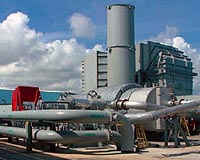 Supercritical Carbon Dioxide Brayton Cycle Turbines Promise Giant Leap
Albuquerque NM (SPX) Mar 07, 2011 Sandia National Laboratories researchers are moving into the demonstration phase of a novel gas turbine system for power generation, with the promise that thermal-to-electric conversion efficiency will be increased to as much as 50 percent - an improvement of 50 percent for nuclear power stations equipped with steam turbines, or a 40 percent improvement for simple gas turbines. The system is als ... read more |
|
|
| The content herein, unless otherwise known to be public domain, are Copyright 1995-2010 - SpaceDaily. AFP and UPI Wire Stories are copyright Agence France-Presse and United Press International. ESA Portal Reports are copyright European Space Agency. All NASA sourced material is public domain. Additional copyrights may apply in whole or part to other bona fide parties. Advertising does not imply endorsement,agreement or approval of any opinions, statements or information provided by SpaceDaily on any Web page published or hosted by SpaceDaily. Privacy Statement |


 del.icio.us
 Digg
Digg Reddit
 YahooMyWeb
 Google
 Facebook


