
 |
 |
 |
 |
 |
 |
 |
 |
 |

 |
Joint ESA/NASA Mission Will Use SPICE To Explore Sun
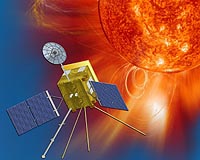
Boulder CO (SPX) Mar 23, 2009 An imaging coronal spectrograph called SPICE (Spectral Imaging of the Coronal Environment), designed by scientists and engineers at Southwest Research Institute in Boulder has been selected by ESA and NASA for the European Space Agency's Solar Orbiter mission to explore the innermost regions of the solar system from the closest distances to the Sun ever attempted. Solar Orbiter will be positioned at a unique vantage point, about one-fourth the distance of the Earth from the Sun. The SPICE instrument is one of 10 selected to fly aboard the joint ESA/NASA Solar Orbiter mission. SPICE will measure different wavelengths of light emitted from the Sun to evaluate its plasma properties and composition with unprecedented spatial and spectral resolution. Measuring these plasma properties remotely with SPICE together with in-situ measurements from other instruments on the Solar Orbiter spacecraft will help researchers understand the connection between the solar wind and its source regions near the Sun. The data will advance our knowledge of the Sun's dynamics to better understand its effects on Earth and the solar system. "SPICE is uniquely suited to fill a critical gap in our understanding of the basic conditions near the Sun and how these conditions effect the solar wind and the space environment near Earth," says Dr. Don Hassler, SPICE principal investigator and senior research scientist in the Boulder office of SwRI's Space Science and Engineering Division. The SPICE investigation is part of NASA's Living with a Star Program, which is designed to understand how and why the Sun varies, how planetary systems respond, and the effects on human space and Earth activities. NASA's Goddard Space Flight Center manages the program for the agency's Heliophysics Division of the Science Mission Directorate. "One of the greatest threats to human space exploration is the sudden, unpredictable occurrence of radiation outbursts from the Sun," says Hassler. "Even satellites and power grids on and around Earth are at risk. By improving our understanding of the dynamics of the Sun, SPICE will help develop the capability for forecasting and predicting solar conditions that could affect space travelers as well as life here on Earth." SwRI is leading the development of SPICE, in collaboration with NASA's Goddard Space Flight Center (Greenbelt, Md.), Rutherford Appleton Laboratory (United Kingdom), Max Planck Institute (Germany), Institut d'Astrophysique Spatiale (France) and Institute for Theoretical Physics (Norway). The Solar Orbiter spacecraft is currently scheduled for launch in 2017. Since the early 1990s, SwRI has developed instruments and spacecraft that measure radiation levels and observe heliospheric interactions, including the Radiation Assessment Detector (RAD) onboard the Mars Science Laboratory (MSL), the Imager for Magnetopause-to-Aurora Exploration (IMAGE) spacecraft, and the forthcoming Magnetospheric Multiscale (MMS) spacecraft. Share This Article With Planet Earth
Related Links Southwest Research Institute Solar Science News at SpaceDaily
 Contracts Awarded For Science Instruments On Solar Mission
 Washington DC (SPX) Mar 23, 2009
NASA has selected three teams to design and build science instruments for a proposed European-led solar mission. The instruments, with a total value of approximately $81 million, are part of NASA's Living with a Star Program. |
|
|

| The content herein, unless otherwise known to be public domain, are Copyright 1995-2007 - SpaceDaily.AFP and UPI Wire Stories are copyright Agence France-Presse and United Press International. ESA Portal Reports are copyright European Space Agency. All NASA sourced material is public domain. Additional copyrights may apply in whole or part to other bona fide parties. Advertising does not imply endorsement,agreement or approval of any opinions, statements or information provided by SpaceDaily on any Web page published or hosted by SpaceDaily. Privacy Statement |
 del.icio.us
 Digg
Digg Reddit
 YahooMyWeb
 Google
 Facebook