
 |
 |
 |
 |
 |
 |
 |
 |
 |

 |
Largest Collection Of Anomalous White Dwarfs Seen In New Hubble Images
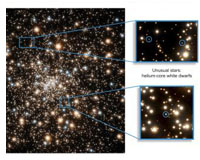
San Francisco CA (SPX) Apr 27, 2009 Twenty-four unusual stars, 18 of them newly discovered, have been observed in new Hubble telescope images. The stars are white dwarfs, a common type of dead star, but they are odd because they are made of helium rather than the usual carbon and oxygen. This is the first extensive sequence of helium-core white dwarfs to be observed in a globular cluster, a dense swarm of some of the oldest stars in our galaxy. A study, accepted for publication in the Astrophysical Journal, suggests that these helium-core white dwarfs have had their lives cut short because of their orbital dance around a partner star. "Helium-core white dwarfs have only about half the mass of typical white dwarfs, but they are found concentrated in the center of the cluster" said Adrienne Cool, professor of physics and astronomy at San Francisco State University, who co-authored the study with graduate student Rachel R. Strickler. "With such low masses, the helium-core white dwarfs ought to be floating all around the cluster, according to theory. The fact that we find them only in the central regions suggests that they have heavy companions - partner stars that anchor them to the cluster center." Being coupled with companions also helps explain the stars' atypical chemical make up. White dwarfs are stars that have reached the end of their lives and have run out of fuel. Most stars burn their fuel leaving behind a dense ball of carbon and oxygen, but these white dwarfs are made of helium. Cool suggests that a star that goes on to become a helium-core white dwarf must have a close companion so that when the star became a red giant and expanded, its outer layers spilled onto the companion. The star never had the chance to reach maturity and burn its helium into carbon and oxygen. The study focused on star cluster NGC 6397, one of the globular clusters closest to Earth at approximately 7,200 light years away. Six helium-core white dwarfs have been observed before in this cluster. Cool and colleagues discovered the first three in 1998. "This is the first time that helium-core white dwarf stars have been discovered in partnerships with other white dwarfs in a globular cluster," Cool said. "This large sample allows us to answer questions about the mass and nature of the partner stars, and the prevalence of these kinds of binaries in the globular cluster." Binary stars play an important role in the evolution of star clusters. Their continual dance around each other provides energy to the cluster that astronomers believe can help prevent black holes from forming. From the data, Cool and her team are able to infer that one to five percent of stars in this globular cluster will end their lives as helium-core white dwarfs with companion stars, a finding that will help improve theoretical models of cluster dynamics. "It may not sound like a lot but it doesn't take many binaries to stir things up," Cool said. One finding remains a mystery. Despite the Hubble camera's high level of sensitivity, the faintest helium-core white dwarfs appear to be missing. "It's possible that these helium-core white dwarfs cool so slowly that they haven't had time to get very faint yet," Cool said. Another possibility is that the oldest binaries containing helium-core white dwarfs have been destroyed by interactions with other stars in the cluster. Share This Article With Planet Earth
Related Links San Francisco State University Space Telescope News and Technology at Skynightly.com
 Payload for Space Shuttle Atlantis Wrapped And Delivered
 Cape Canaveral FL (SPX) Apr 27, 2009
The payload canister with the Hubble Space Telescope equipment arrives at the base of Launch Pad 39A where space shuttle Atlantis stands. Image Credit: NASA/Kim Shiflett STS-125: Mission to Service NASA's Hubble Space Telescope |
|
|

| The content herein, unless otherwise known to be public domain, are Copyright 1995-2007 - SpaceDaily.AFP and UPI Wire Stories are copyright Agence France-Presse and United Press International. ESA Portal Reports are copyright European Space Agency. All NASA sourced material is public domain. Additional copyrights may apply in whole or part to other bona fide parties. Advertising does not imply endorsement,agreement or approval of any opinions, statements or information provided by SpaceDaily on any Web page published or hosted by SpaceDaily. Privacy Statement |
 del.icio.us
 Digg
Digg Reddit
 YahooMyWeb
 Google
 Facebook