
 |
 |
 |
 |
 |
 |
 |
 |
 |

 |

Washington DC (SPX) Sep 21, 2010 Piezoelectric materials have fantastic properties: squeeze them and they generate an electrical field. And vice-versa, they contract or expand when jolted with an electrical pulse. With a name derived from the Greek word meaning to squeeze or press, the piezoelectric effect was just a curiosity after it was discovered in several crystals in 1880. But in 1917, a quartz piezoelectric crystal was at the heart of the world's first submarine-detecting sonar. Piezoelectric materials really took off after the 1950s, with the development of a superior man-made piezoelectric ceramic crystal: lead zirconate titanate, or PZT (the initials of its chemical symbols). Over the past 60 years, PZT has been essential for myriad high-tech applications: from inkjet printers to digital camera shutters, ultrasonic imagers, fuel injector actuators, and igniters for gas barbecue grills. Despite this success, many scientists now want to replace PZT with some as yet undiscovered lead-free material that would be more environmentally benign and that would enable new piezoelectric applications in biological settings. To date, however, no suitable successors have been found. Candidates are typically too feeble in their piezoelectric effect and/or physical durability. A Swiss scientist, Dragan Damjanovic, thinks researchers should be looking more broadly. He says nearly all of today's efforts are focused on materials whose ions and electrons - the ultimate source of the piezoelectric effect - behave in a particular manner, called polarization rotation. His theoretical calculations have shown that another, overlooked behavior - polarization extension, present in other classes of materials - can also generate an enhanced piezoelectric effect. An article by Damjanovic in the journal Applied Physics Letters, which is published by the American Institute of Physics, details his ideas and supporting evidence. In particular, he proposes a particular type of phase diagram that he believes will lead to improved, lead-free piezoelectric materials. "What I have done is at odds with the dominant thinking," Damjanovic admits. "But I offer a different approach to an important problem." The article, "A morphotropic phase boundary system based on polarization rotation and polarization extension" by Dragan Damjanovic appears in the journal Applied Physics Letters.
Share This Article With Planet Earth
Related Links American Institute of Physics Powering The World in the 21st Century at Energy-Daily.com

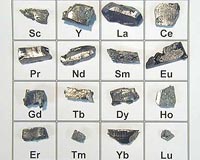 China corners world 'rare earth' supply
Washington (UPI) Sep 1, 2010 China's monopoly on elements used in computer disc drives, electric cars, military weapons and other key products could mean a crisis for the West, experts say. China's control of the supply of most of the world's "rare earth" elements, and its increasingly hard-line stand on limiting exports, could create a supply crisis for the United States and other countries, an article in the maga ... read more |
|
|
| The content herein, unless otherwise known to be public domain, are Copyright 1995-2010 - SpaceDaily. AFP and UPI Wire Stories are copyright Agence France-Presse and United Press International. ESA Portal Reports are copyright European Space Agency. All NASA sourced material is public domain. Additional copyrights may apply in whole or part to other bona fide parties. Advertising does not imply endorsement,agreement or approval of any opinions, statements or information provided by SpaceDaily on any Web page published or hosted by SpaceDaily. Privacy Statement |


 del.icio.us
 Digg
Digg Reddit
 YahooMyWeb
 Google
 Facebook


