
 |
 |
 |
 |
 |
 |
 |
 |
 |

 |
Lightest Exoplanet Yet Discovered
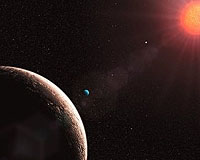
Garching, Germany (SPX) Apr 23, 2009 Well-known exoplanet researcher Michel Mayor has announced the discovery of the lightest exoplanet found so far. The planet, "e", in the famous system Gliese 581, is only about twice the mass of our Earth. The team also refined the orbit of the planet Gliese 581 d, first discovered in 2007, placing it well within the habitable zone, where liquid water oceans could exist. These amazing discoveries are the outcome of more than four years of observations using the most successful low-mass-exoplanet hunter in the world, the HARPS spectrograph attached to the 3.6-metre ESO telescope at La Silla, Chile. "The holy grail of current exoplanet research is the detection of a rocky, Earth-like planet in the 'habitable zone' - a region around the host star with the right conditions for water to be liquid on a planet's surface", says Michel Mayor from the Geneva Observatory, who led the European team to this stunning breakthrough. Planet Gliese 581 e orbits its host star - located only 20.5 light-years away in the constellation Libra ("the Scales") - in just 3.15 days. "With only 1.9 Earth-masses, it is the least massive exoplanet ever detected and is, very likely, a rocky planet", says co-author Xavier Bonfils from Grenoble Observatory. Being so close to its host star, the planet is not in the habitable zone. But another planet in this system appears to be. From previous observations - also obtained with the HARPS spectrograph at ESO's La Silla Observatory and announced two years ago - this star was known to harbor a system with a Neptune-sized planet (ESO 30/05) and two super-Earths (ESO 22/07). With the discovery of Gliese 581 e, the planetary system now has four known planets, with masses of about 1.9 (planet e), 16 (planet b), 5 (planet c), and 7 Earth-masses (planet d). The planet furthest out, Gliese 581 d, orbits its host star in 66.8 days. "Gliese 581 d is probably too massive to be made only of rocky material, but we can speculate that it is an icy planet that has migrated closer to the star," says team member Stephane Udry. The new observations have revealed that this planet is in the habitable zone, where liquid water could exist. "'d' could even be covered by a large and deep ocean - it is the first serious 'water world' candidate," continued Udry. The gentle pull of an exoplanet as it orbits the host star introduces a tiny wobble in the star's motion - only about 7 km/hour, corresponding to brisk walking speed - that can just be detected on Earth with today's most sophisticated technology. Low-mass red dwarf stars such as Gliese 581 are potentially fruitful hunting grounds for low-mass exoplanets in the habitable zone. Such cool stars are relatively faint and their habitable zones lie close in, where the gravitational tug of any orbiting planet found there would be stronger, making the telltale wobble more pronounced. Even so, detecting these tiny signals is still a challenge, and the discovery of Gliese 581 e and the refinement of Gliese 581 d's orbit were only possible due to HARPS's unique precision and stability. "It is amazing to see how far we have come since we discovered the first exoplanet around a normal star in 1995 - the one around 51 Pegasi," says Mayor. "The mass of Gliese 581 e is 80 times less than that of 51 Pegasi b. This is tremendous progress in just 14 years." The astronomers are confident that they can still do better. "With similar observing conditions an Earth-like planet located in the middle of the habitable zone of a red dwarf star could be detectable," says Bonfils. "The hunt continues." This discovery was announced at the JENAM conference during the European Week of Astronomy and Space Science, which is taking place at the University of Hertfordshire, UK. The results have also been submitted for publication in the research journal Astronomy and Astrophysics ("The HARPS search for southern extra-solar planets: XVIII. An Earth-mass planet in the GJ 581 planetary system", by Mayor et al., 2009). The team is composed of M. Mayor, S. Udry, C. Lovis, F. Pepe and D. Queloz (Geneva Observatory, Switzerland), X. Bonfils, T. Forveille , X. Delfosse, H. Beust and C. Perrier (LAOG, France), N. C. Santos (Centro de Astrofisica,Universidade de Porto), F. Bouchy (IAP, Paris, France) and J.-L. Bertaux (Service d'Aeronomie du CNRS, Verri�res-le-Buisson, France). Share This Article With Planet Earth
Related Links ESO Exoplanet media kit Lands Beyond Beyond - extra solar planets - news and science Life Beyond Earth
 Scientists find most Earth-like exoplanet ever: study
 Paris (AFP) April 21, 2009
Astronomers unveiled Tuesday the lightest exoplanet ever detected and, in the same distant solar system, the first "serious candidate" for a world with abundant liquid water, both conditions essential for supporting life. |
|
|

| The content herein, unless otherwise known to be public domain, are Copyright 1995-2007 - SpaceDaily.AFP and UPI Wire Stories are copyright Agence France-Presse and United Press International. ESA Portal Reports are copyright European Space Agency. All NASA sourced material is public domain. Additional copyrights may apply in whole or part to other bona fide parties. Advertising does not imply endorsement,agreement or approval of any opinions, statements or information provided by SpaceDaily on any Web page published or hosted by SpaceDaily. Privacy Statement |
 del.icio.us
 Digg
Digg Reddit
 YahooMyWeb
 Google
 Facebook