
 |
 |
 |
 |
 |
 |
 |
 |
 |

 |
Lockheed Martin F-35B Exceeds STOVL Thrust Requirement
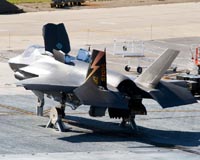
Fort Worth TX (SPX) Apr 27, 2009 The F-35B Lightning II short takeoff/vertical landing (STOVL) variant has demonstrated during testing that it produces excess vertical thrust - more than required to carry out its missions. The tests, conducted on a specially instrumented "hover pit," also validated the performance of aircraft software, controls, thermal management, STOVL-system hardware and other systems. "The performance level measured was absolutely exceptional," said J.D. McFarlan, Lockheed Martin F-35 Air Vehicle lead. "We demonstrated 41,100 pounds of vertical thrust against our requirement of 40,550 pounds.This means we will deliver excellent margin for the vertical landing and short takeoff performance we've committed to our STOVL customers," he said. Those customers include the U.S. Marine Corps, the United Kingdom's Royal Navy and Royal Air Force, and the Italian Navy and Air Force. The F-35B is powered by a single Pratt and Whitney F135 engine driving a Rolls-Royce lift fan. The F135 is the most powerful engine ever flown in a jet fighter. During hover-pit testing, the aircraft is anchored to a metal grate 14 feet above a sloped concrete floor, separating the jet from ground effect and enabling it to simulate free-air flight. Sensors measure thrust and the aircraft's response to pilot inputs. The testing also demonstrates control of the doors associated with the STOVL propulsion system: engine auxiliary inlet, fan inlet, fan exit, roll posts, and doors that open to enable the Rolls-Royce three-bearing swivel duct to articulate and vector engine thrust. In other tests, metal plates are installed atop the hover-pit grate, enabling engineers to observe and chart the outflow of gases from the propulsion system. The testing demonstrates functional operation of all systems required for vertical flight, and measures the installed forces and moments on the aircraft during STOVL operations.The hover-pit tests are the final series of ground tests before airborne STOVL testing begins. "We've demonstrated critical performance such as inlet pressure recovery, pitching moment, rolling and yawing moment, effective vector angles of the exhaust, and control-input response time," said Doug Pearson, vice president of the F-35 Integrated Test Force. "Each of these measurements correlates extremely well with our computer models. The outstanding STOVL performance gives us plenty of confidence to begin in-flight transitions to STOVL-mode flight and ultimately our first vertical landing at the Naval Air Station Patuxent River, Md., this summer." Share This Article With Planet Earth
Related Links Lockheed Martin The latest in Military Technology for the 21st century at SpaceWar.com
 First Phase Of US Army Ground Soldier Ensemble Program Begins
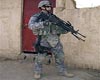 Scottsdale AZ (SPX) Apr 27, 2009
General Dynamics C4 Systems has been awarded one of three $12 million contracts to design a new information-systems ensemble for soldiers to use during combat operations. General Dynamics received one of the Ground Soldier Ensemble contract awards from the U.S. Army's Tank-automotive and Armaments Command (TACOM) Contracting Center in support of Project Manager Soldier Warrior requirements. |
|
|

| The content herein, unless otherwise known to be public domain, are Copyright 1995-2007 - SpaceDaily.AFP and UPI Wire Stories are copyright Agence France-Presse and United Press International. ESA Portal Reports are copyright European Space Agency. All NASA sourced material is public domain. Additional copyrights may apply in whole or part to other bona fide parties. Advertising does not imply endorsement,agreement or approval of any opinions, statements or information provided by SpaceDaily on any Web page published or hosted by SpaceDaily. Privacy Statement |
 del.icio.us
 Digg
Digg Reddit
 YahooMyWeb
 Google
 Facebook