
 |
 |
 |
 |
 |
 |
 |
 |
 |

 |

Paris (ESO) May 20, 2011 ESO's Very Large Telescope (VLT) has teamed up with NASA's Cassini spacecraft to study a rare storm in the atmosphere of the planet Saturn in more detail than has ever been possible before. The new study by an international team will appear this week in the journal Science. The atmosphere of the planet Saturn normally appears placid and calm. But about once per Saturn year (about thirty Earth years), as spring comes to the northern hemisphere of the giant planet, something stirs deep below the clouds that leads to a dramatic planet-wide disturbance (eso9014). The latest such storm was first detected by the radio and plasma wave science instrument on NASA's Cassini spacecraft [1], in orbit around the planet, and also tracked by amateur astronomers in December 2010. It has now been studied in detail using the VISIR [2] infrared camera on ESO's Very Large Telescope (VLT) in conjunction with observations from the CIRS instrument [3] on Cassini. This is only the sixth of these huge storms to be spotted since 1876. It is the first ever to be studied in the thermal infrared - to see the variations of temperature within a Saturnian storm - and the first ever to be observed by an orbiting spacecraft. "This disturbance in the northern hemisphere of Saturn has created a gigantic, violent and complex eruption of bright cloud material, which has spread to encircle the entire planet," explains Leigh Fletcher (University of Oxford, UK), lead author of the new study. "Having both the VLT and Cassini investigating this storm at the same time gives us a great chance to put the Cassini observations into context. Previous studies of these storms have only been able to use reflected sunlight, but now, by observing thermal infrared light for the first time, we can reveal hidden regions of the atmosphere and measure the really substantial changes in temperatures and winds associated with this event." The storm may have originated deep down in the water clouds where a phenomenon similar to a thunderstorm drove the creation of a giant convective plume: just as hot air rises in a heated room, this mass of gas headed upwards and punched through Saturn's usually serene upper atmosphere. These huge disturbances interact with the circulating winds moving east and west and cause dramatic temperature changes high up in the atmosphere. "Our new observations show that the storm had a major effect on the atmosphere, transporting energy and material over great distances, modifying the atmospheric winds - creating meandering jet streams and forming giant vortices - and disrupting Saturn's slow seasonal evolution," adds Glenn Orton (Jet Propulsion Laboratory, Pasadena, USA), another member of the team. Some of the unexpected features seen in the new imaging from VISIR have been named stratospheric beacons. These are very strong temperature changes high in the Saturnian stratosphere, 250-300 km above the cloud tops of the lower atmosphere, that show how far up into the atmosphere the effects of the storm extend. The temperature in Saturn's stratosphere is normally around -130 degrees Celsius at this season but the beacons are measured to be 15-20 degrees Celsius warmer. The beacons are completely invisible in reflected sunlight but can outshine the emission from the rest of the planet in the thermal infrared light detected by VISIR. They had never been detected before, so astronomers are not sure if they are common features in such storms. "We were lucky to have an observing run scheduled for early in 2011, which ESO allowed us to bring forward so that we could observe the storm as soon as possible. It was another stroke of luck that Cassini's CIRS instrument could also observe the storm at the same time, so we had imaging from VLT and spectroscopy of Cassini to compare," concludes Leigh Fletcher. "We are continuing to observe this once-in-a-generation event."
Notes: [2] VISIR is the VLT spectrometer and imager for the mid-infrared. VISIR was built by CEA/DAPNIA/SAP and NFRA/ASTRON. [3] CIRS stands for Composite Infrared Spectrometer, one of the instruments on Cassini. CIRS analyses heat radiation and is capable of discerning an object's composition. This research was presented in a paper to appear in the journal Science on 19 May 2011.
Share This Article With Planet Earth
Related Links ESO Explore The Ring World of Saturn and her moons Jupiter and its Moons The million outer planets of a star called Sol News Flash at Mercury

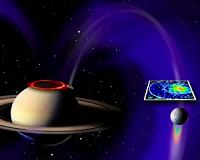 Electron Beams Link Saturn with Its Moon Enceladus
Pasadena CA (JPL) Apr 25, 2011 Data from NASA's Cassini spacecraft have revealed that Enceladus, one of Saturn's diminutive moons, is linked to Saturn by powerful electrical currents - beams of electrons that flow back and forth between the planet and moon. The finding is part of a paper published in Nature. CAPS, one of the instruments on board Cassini which made the electron beam discovery, includes a electron sensor ... read more |
|
|
| The content herein, unless otherwise known to be public domain, are Copyright 1995-2010 - SpaceDaily. AFP and UPI Wire Stories are copyright Agence France-Presse and United Press International. ESA Portal Reports are copyright European Space Agency. All NASA sourced material is public domain. Additional copyrights may apply in whole or part to other bona fide parties. Advertising does not imply endorsement,agreement or approval of any opinions, statements or information provided by SpaceDaily on any Web page published or hosted by SpaceDaily. Privacy Statement |


 del.icio.us
 Digg
Digg Reddit
 YahooMyWeb
 Google
 Facebook


